Car Dealers and Mechanics: The Google Review About a Price That Changed
2026-09-24
The quote said one figure, the invoice said another, and now the review says "crooks". Or the trade-in was valued lower once the car was on the lot, and the customer walked out and wrote about it on the way home. Price reviews are the everyday complaint of the motor trade, and they hurt because the next customer is already nervous about being overcharged.
Most of these reviews will stay. One kind of wording inside them will not, and the reply under the rest does more to reassure the next customer than the review does to scare them off.
How a price changes, and how it ends up in a review
Almost every price review in the motor trade comes from one of a handful of moments:
- The job that grew once it was open. A service booked at a set price, then the brake rotors were below minimum, the water pump was weeping when the timing belt came off, or a seized bolt snapped and had to be drilled out.
- The diagnostic fee. The customer declined the repair and was surprised to pay for the time it took to find the fault.
- The parts price. The quote was based on one part, and the one that fits, or the one available this week, cost more.
- The "from" price. A logbook service advertised from a figure, then fluids, filters and consumables took it higher.
- The drive-away figure. At a dealership, the price at signing included delivery charges or add-ons the buyer did not expect.
- The trade-in. A figure given over the phone or from photos dropped once the appraiser drove the car.
Each is a first-hand account of a real experience with your business. Google does not decide whether the rotors really needed replacing or whether the appraisal was fair, so the review stays up however one-sided it is. The same goes for opinions about price: "overpriced", "charged way more than quoted", "ripped off on the trade-in" and "felt like they were padding the bill" are all allowed. Customers can think you charge too much and say so.
Where the price review crosses the line
The breach is a label: the reviewer stops describing the bill and tells the world your business is criminal, stated flatly as a fact. That falls under Misrepresentation.
Wording that qualifies (invented examples):
- "Crooks. Stay well away from this workshop."
- "This dealership is a scam run by con artists."
Wording that only looks similar:
- "Quoted one price, charged nearly double. Never again." An account of the bill.
- "Felt like they invent faults to pad the invoice." A feeling, framed as theirs.
- "Dodgy." A dig at your honesty, not a flat accusation of a crime. Worth a free report, but not where to spend your appeal.
Motor trade reviews tend to be long, because the customer wants to lay out every line of the invoice. Read to the very end. The final line is where "absolute crooks, avoid" usually sits, and that line is the case. The paragraphs about the invoice stay. Our post on reviews calling a business a scam goes deeper on the label versus account distinction, with an appeal we won on a "scammers" review.
Reporting the label without arguing the invoice
Take a screenshot of the review first. Then open Google's Reviews Management Tool while signed in to the account that manages your profile, choose "Report a new review", click Report beside it and pick Spam. This screen has no reason called Misrepresentation and no text box, so Spam carries this breach. From the public listing or the Maps app, where Spam is not offered, Low quality information is the nearest match.
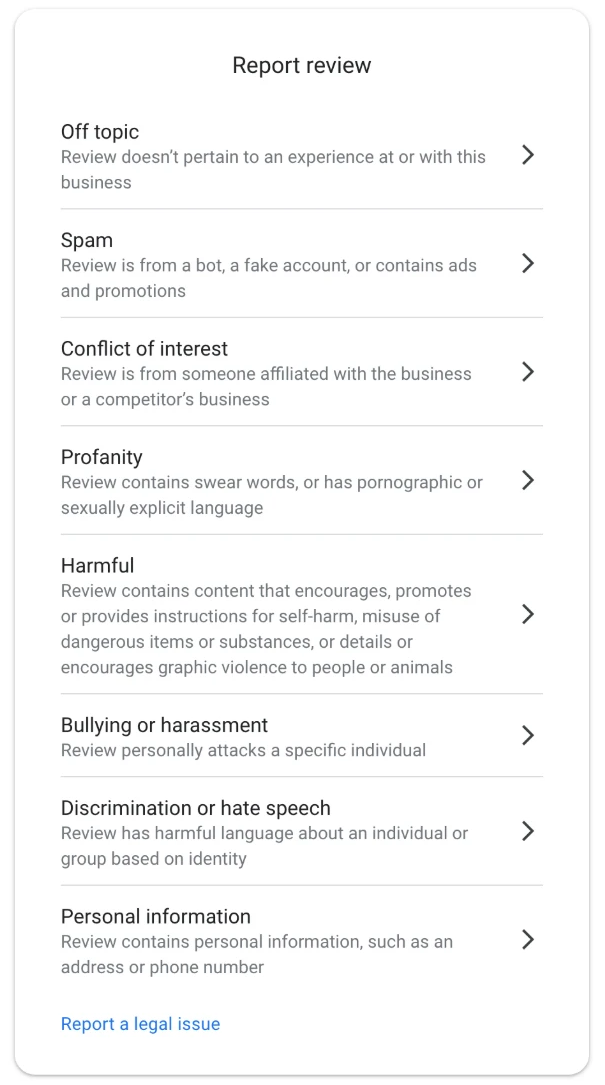
The eight reasons in the tool. For "crooks" or "scammers", pick Spam.
If the report comes back "Report reviewed, no policy violation", the review becomes eligible for one appeal. The policy field takes Misrepresentation, and the explanation quotes the label, names the policy and connects the two.
This is where workshops and dealers most often undo their own case. The instinct is to attach the job card, the photos of the worn rotors and the signed authorisation, and explain why the extra work was needed. All of that turns the appeal into a dispute about the repair, and Google does not settle disputes. The label is your evidence, and it is enough. The Google Review Removal Playbook has the appeal template for this breach, with a worked example you can follow line by line.
The reviewer who only got a quote
A common frustration in the trade: someone rang for a price or brought the car in for a quote, went elsewhere, and then left a one-star review calling you expensive. They never paid you a cent, so it feels like they should not get a vote.
They do. A quote, an enquiry, a phone call or an appraisal is an experience with your business, and a review of it is allowed. "Quoted $1,400 for a clutch, got it done down the road for less" is a real account of a real quote. There is no never-a-customer case here, and filing one wastes the report.
Read the review again for the label instead. A quote shopper who writes "rip-off" has an opinion; one who writes "these people are thieves" has handed you the breach. If the review is only about price, the reply is where you win it, and a short line about what the quote included often answers the complaint for every reader who comes after.
The reply: one sentence on variations, then bring the invoice in
The reply is written for the next person choosing between you and the workshop down the road. They are asking one question: if I leave my car here, will the price change without my say?
A reply that answers it does four things:
- Acknowledges that the bill was more than expected, without conceding that anything was wrong with it.
- Explains how variations work in one plain sentence, so the next reader knows what to expect.
- Invites the customer to bring the invoice in and go through it with a named person, such as the service manager or the sales manager.
- Keeps the job private. No amounts, no part numbers, no list of faults found, no details of their car, their finance or their trade-in.
The single sentence does most of the work, for example: "If we find more work once a job is open, we call you for approval before we go any further." Readers can hold you to that, which is why it reassures them.
Leave the label alone in your reply. "We are not crooks" puts the word under your business name a second time. Describe how you work instead, and let the reader draw the conclusion.
One piece of pushback, because it matters more than any reply. If the workshop did not ring for approval before doing the extra work, the review has found a real problem, and the reply should own it plainly rather than defend it. A clear variation process, recorded on the job card every time, prevents more of these reviews than any response can fix. Our post on how to respond to a Google review about price covers price complaints across other industries, and the price reply template in the playbook is built for the quote-versus-invoice case. Our review removal page for dealers and mechanics covers how we approach motor trade profiles more broadly.
Before you report or reply
Put the invoice down and read the review as the next customer would.
- Is there a flat label: crooks, scammers, thieves, fraud, con artists? If yes, screenshot it and report it as Spam today.
- Is it only about price or value, or only about a quote? It stays. Write the reply.
- Did the price change without the customer's approval? Then the reply owns it, and the process gets fixed this week.
Post the reply the same day you report. If the review comes down, the reply goes with it. If it stays, the next customer reads one calm sentence about how you handle a job that grows, right under the complaint that it did.
Answer price reviews, remove the crooks ones
Get the appeal template for crooks and scammers labels and the price reply that turns a quote-versus-invoice complaint into reassurance for your next customer.
Get the Playbook · $99Several locations or a group? Talk to us about a managed service · Popular locations: Sydney · Melbourne · Brisbane · Perth · Adelaide · Gold Coast · all locations