When a Google Review Names Your Dental Nurse or Receptionist: What a Practice Can Do
2026-09-24
A patient has left a one-star review, and it names your receptionist, or the dental nurse who was beside the chair. It might be about a gap payment that came as a shock, a fee for a missed appointment, or a morning when the list ran forty minutes behind. The person named has read it, and so has every new patient who looked up the practice this week.
A practice has fewer moves here than most businesses. You cannot discuss the appointment in public, and you cannot answer one unfair review by drumming up praise for your treatment. What you can do is work out quickly whether the words have crossed the line Google acts on, and write a reply that protects the patient's privacy and your staff member at the same time.
Why your front desk and nurses are the ones named
In dental and medical practices, the people patients remember by name are often not the clinicians. They are the receptionist who took the card, the person who rang about the cancellation fee, and the nurse who was in the room while the patient was anxious or in pain. They introduce themselves by first name, many wear name badges, and they handle the moments patients find hardest.
The reviews that name them tend to follow a few patterns:
- Money at the desk. The estimate that did not match the bill, the health fund rebate that was smaller than expected, the deposit taken before a crown. The receptionist says the number out loud, so the receptionist gets named.
- Fees for missed or late-cancelled appointments. The patient feels the rule was applied without sympathy, and the person who applied it is the one on the phone.
- Waiting. A long wait with no explanation lands on whoever is at the front desk.
- Chairside. An anxious patient who felt rushed, spoken over or handled roughly, and who remembers the nurse's name from the start of the appointment.
- Children's appointments. A parent unhappy with how a staff member spoke to their child.
Most of these are accounts of a visit, and they stay up however unfair they feel. Some go further, and those are the ones worth your time.
Naming is allowed. The attack is the breach.
Reviewers are allowed to name the people who served them. "[Name] at reception was short with me about the gap fee" names someone and describes how the patient was treated. That is feedback about the service, and it is not a breach on its own. Reporting a review just because a staff member's name is in it is one of the most common reasons reports fail.
The breach is what the review does to the named person. When it stops describing the service and starts going after them as a person, their competence, their character, their looks or their right to have the job, it falls under Google's Harassment policy.
Wording that qualifies (invented examples, with the name removed):
- "[Name] on reception is a nasty piece of work and should not be allowed anywhere near patients."
- "Whoever hired [name] as a dental nurse wants their head read. Useless and cold."
Wording that only looks similar:
- "[Name] didn't explain the fees and I was embarrassed at the counter." Named, and describing how the patient was treated. Allowed.
- "The nurse was rough and clearly hates her job." A personal dig, but no name. In a practice with one nurse you may feel everyone knows who it means, but the rule looks at what is on the page, and there is no identifiable individual there.
A quick test: cover the name and read what is left. If what remains describes the visit (rude, rushed, did not explain the bill), the review stays. If what remains is a verdict on the person, and a name really is there, you have a case. Swearing aimed at the named person on top of the attack makes it stronger again. Our post on removing a review that attacks an employee walks through that line in more depth, including an appeal we won for a named manager.
The nurse is protected more than the principal dentist
Google gives much more room to criticism of the owner, or of whoever is the public face of a business, than of a junior employee. In a practice, the principal dentist is usually both.
That means a review saying the dentist who treated them rushed a filling, missed something on an X-ray or charged too much is an account of clinical care, and it stays, even when you are sure it is wrong. A review that turns personal about the principal ("a disgrace who should be struck off") is still worth a free report as Bullying or harassment, and the less it has to do with the treatment, the better its chance. But it is a weaker case than the same words aimed at the receptionist.
The receptionist and the nurse did not choose to be the face of the practice. A review that goes after one of them personally is the kind of content the rule exists to catch.
One thing that is not a breach, although it can feel like one: "I'm reporting you to AHPRA." A patient saying they will complain to a regulator or a health complaints body is a threat of a complaint, not a threat of harm, and it stays. Our post on swearing and threats in reviews explains where that line sits.
Reporting it, and the policy for the appeal
Take a screenshot of the review first, so you have the original if it is edited later. Then open Google's Reviews Management Tool, signed in to the account that owns or manages the practice's Business Profile, click Report beside the review and pick Bullying or harassment. The same reason is offered on the public listing and in the Maps app.
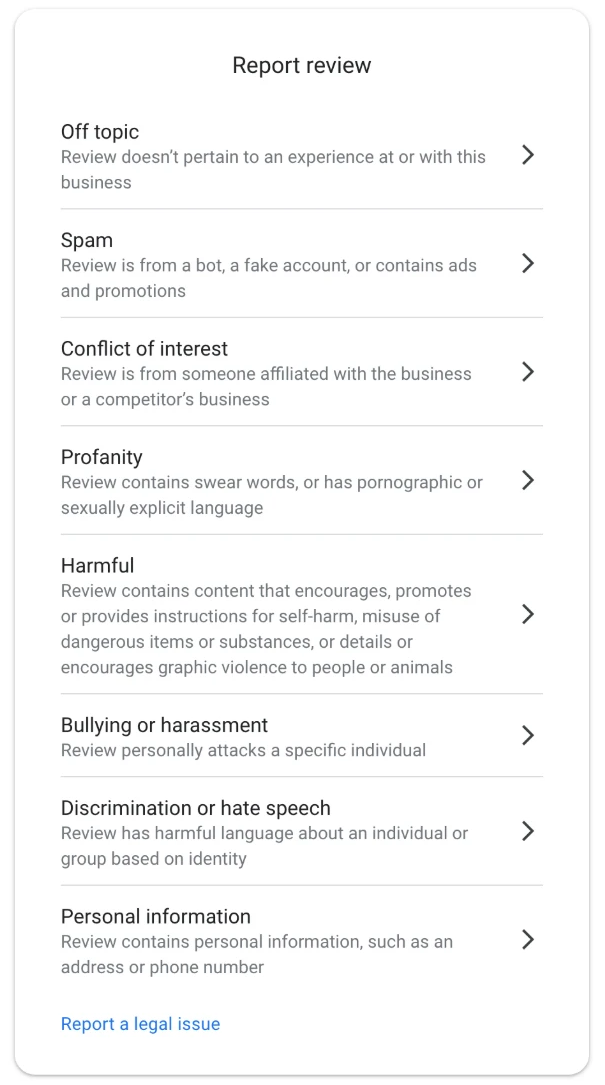
For a personal attack on a named staff member, pick Bullying or harassment.
If the decision comes back "Report reviewed, no policy violation", check the status in the tool. If the review is eligible for appeal, type Harassment as the policy, then quote the words aimed at your staff member exactly as written and show that they target a named person rather than describe the visit.
For a health practice, this has a useful side effect. A strong appeal is about the reviewer's words and the rule, and nothing else, so it never needs a single detail from the patient's file: not the treatment, not the fees, not whether they attended. If you find yourself explaining the appointment, you have drifted into an argument Google will not referee. The wording that ties the quote to the policy is where these appeals are won, and The Google Review Removal Playbook has the template for a personal attack on a named employee with a worked example.
The staff member who was attacked can also report the review from their own Google account, under the same reason. That is their right, because it is their name. Asking the rest of the team, or your patients, to report it as well is treated as manipulation and puts the practice's profile at risk.
The reply: privacy first
This is where a practice differs most from a café or a plumber. The reply every other business can use for a reviewer it does not recognise ("we cannot match this to a visit in our records") is off limits to you, and so is its opposite.
- Do not confirm or deny that the reviewer is a patient. Under Australian privacy law, the fact that someone attended a health practice is itself health information. "We have checked your records" confirms it. "You have never been a patient here" denies it. Both say something about a person's health care in public.
- Speak in general terms. You can describe how the practice works (every patient gets a written estimate before treatment starts, fees for missed appointments are explained at booking) as long as the sentence is about your practice, not about this person.
- Do not repeat the staff member's name. The reviewer put it there once. Writing it again puts it next to the criticism a second time, under the practice's name.
- Invite direct contact. Name the practice manager and give a phone number or email that a person answers.
- Do not answer it with solicited praise. AHPRA's advertising rules restrict testimonials about clinical care, so the response to one bad review is never a push asking patients to post about their treatment, and never quoting good reviews in your advertising.
A sentence that does the job without confirming anything: "We expect everyone who contacts our practice to be treated with patience and respect, and our practice manager would like to hear more on the number below." Notice it says "contacts", not "visits", and names no one.
The playbook's reply template for a complaint about how a staff member treated someone is the base for this reply, and it needs only the privacy adjustments above. Our guide to responding when a review names staff covers the wider approach, including what never to say about the employee.
Talk to the person named before you post
Show your nurse or receptionist the review and the reply you plan to post, the same day, so nothing reaches them second-hand. Ask what happened rather than whether it happened. If the patient has a point, deal with it privately, the way you would deal with any service problem. If they do not, your public reply still says nothing about it.
Then tell them two things plainly: their name will not appear in your reply, and if the review goes beyond the service and attacks them as a person, the practice will report it. Our page on Google review removal for dental practices covers the other patterns practices see.
Before you reply to any review that names someone at your practice, read it once with the name covered and once with the patient's privacy in mind: the first read tells you whether to report it, and the second tells you what you are allowed to say.
Protect your team without breaching privacy
Get the exact appeal wording for a personal attack on named staff, plus the reply adjusted so it never confirms or denies a patient.
Get the Playbook · $99Several locations or a group? Talk to us about a managed service · Popular locations: Sydney · Melbourne · Brisbane · Perth · Adelaide · Gold Coast · all locations