A Google Review Attacks One of Your Staff by Name. Here Is the Line Google Draws.
2026-09-24
A review has named someone on your team, and it is not kind. It might be your receptionist, a junior on their second week, or a manager who was trying to calm down a difficult customer. They have read it. So has everyone who looked you up this week.
Whether it can come down depends on one distinction, and most owners have it the wrong way round.
Naming your staff is allowed. Attacking them is not.
Reviewers are allowed to name the people who served them. The dentist, the agent, the stylist, the manager: anyone who deals with the public as part of your business can be named in a review, and naming them is not a breach on its own. Reporting a review simply because it mentions someone by name is one of the most common reasons reports fail.
The breach is what the review does to that named person. When it stops describing the service and starts going after them as a person, it falls under Google's Harassment policy. The shift shows up in four places:
- Competence as a person, not as a server: they are too stupid or useless to be employed at all.
- Character: calling them a liar, a creep or a nasty piece of work.
- Looks: anything about their appearance.
- Their right to the job: they should be sacked, or have no business being a manager.
Staff names turn up in more reviews than most owners expect. We looked at how often, and what it means for a profile, in our data on Google reviews that name staff.
Wording that qualifies, and wording that only looks similar
Wording that qualifies (invented examples, with the name removed):
- "[Name] is clueless and has no business running a front desk."
- "Whoever hired [name] should be embarrassed. Lazy and thick."
Wording that only looks similar:
- "[Name] was rude and didn't listen to a word I said." Named, and describing how the reviewer was treated. Allowed.
- "The manager was rough and is in the wrong industry." A personal dig, but no name, so no identifiable individual is being targeted.
A quick way to test it: cover the name with your thumb and read what is left. If what remains describes the service (rude, slow, unhelpful, got my order wrong), the review stays. If what remains is a verdict on the person, and a name really is there, you have a case.
Swearing at a named employee is the strongest case
When profanity is aimed at a named employee on top of a personal attack, you have the strongest everyday case there is, and it is one we file constantly. Something like "Sh*t attitude from [name], who should never be let near customers" does both at once: it swears at the person and it questions their right to the job.
Swearing on its own falls under a different rule, which we cover in swearing and threats in Google reviews. When a review both swears at and attacks a named employee, file it as harassment. That reason covers the whole of what the review is doing to the person, not just the rude word.
The owner gets less room than a junior employee
Google gives much more room to criticism of the owner, or of whoever is the public face of the business, than of a junior employee. "The owner is a liar and a disgrace" is still worth a free report, and the more personal it is and the less it has to do with the service, the better your chance. But it is a weaker case than the same words aimed at a casual staff member who happened to be on shift that night.
That second person is the one the rule protects most clearly. They did not choose to be the face of your business, and a review that goes after them personally is the kind of content the policy exists to catch.
How to report it and what goes in the appeal
Report it from Google's Reviews Management Tool, signed in to the account that owns or manages your profile, after taking a screenshot of the review. Click Report beside the review and pick Bullying or harassment. The same reason appears on the public listing and in the Maps app, so it does not matter which screen you use. Our guide to reporting a Google review as the business owner shows each route.
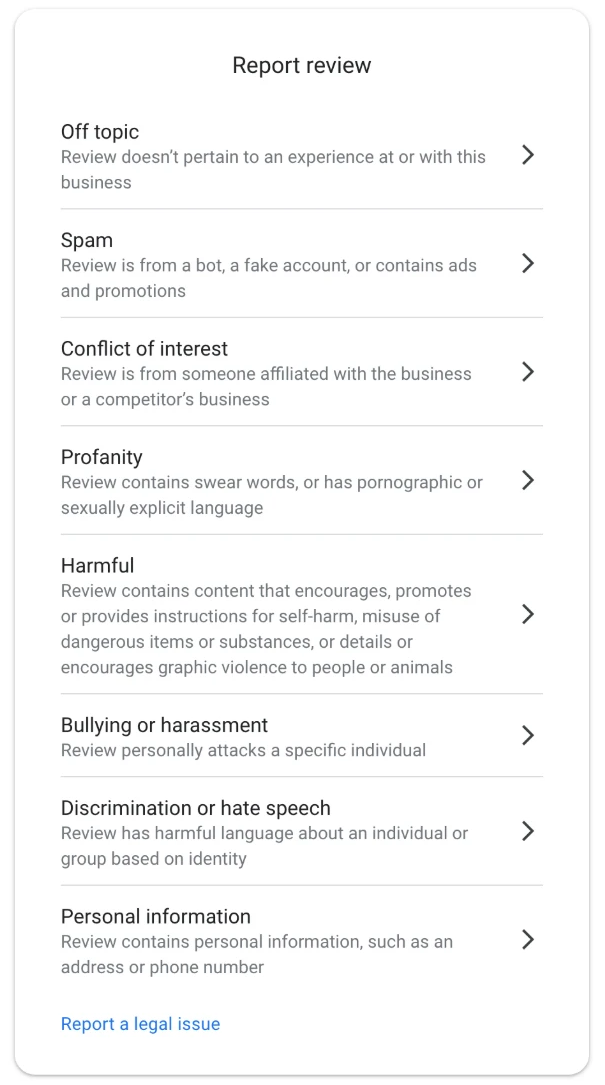
For a personal attack on a named employee, pick Bullying or harassment.
If the report comes back "no policy violation", the review becomes eligible for appeal. In the policy field, type Harassment. In the explanation, quote the attack word for word, including any masked swearing exactly as it was written, show that it targets a named individual rather than describing the service, and ask for removal.
Leave out everything else. How hard your employee works, how long they have been with you and what really happened at the counter are all true and all beside the point. The appeal is about the words and the rule. The wording that ties the quote to the policy is the part that wins it, and The Google Review Removal Playbook has the template for this breach with a worked example.
There is one more route. The person who was attacked can report the review from their own Google account, as a separate report under the same reason. That is their right, because it is their name. Asking other staff, friends or family to report it as well is treated as manipulation and puts your profile at risk, so keep it to the person targeted.
The appeal we won for a named manager
A client's manager, Dylan (not his real name), was named in a one-star review from a real customer who was unhappy with the service. The review called him out by name, said he claimed to be the manager but should not be because he knew nothing about customer service, and swore at him more than once.
We reported it as Bullying or harassment. The first report came back "no policy violation". We appealed under Harassment. The appeal quoted the two worst lines exactly as written, asterisks included, showed that the words had moved from feedback about the business to abuse of one employee by name, and asked for removal. It did not argue about whether the service complaint was fair.
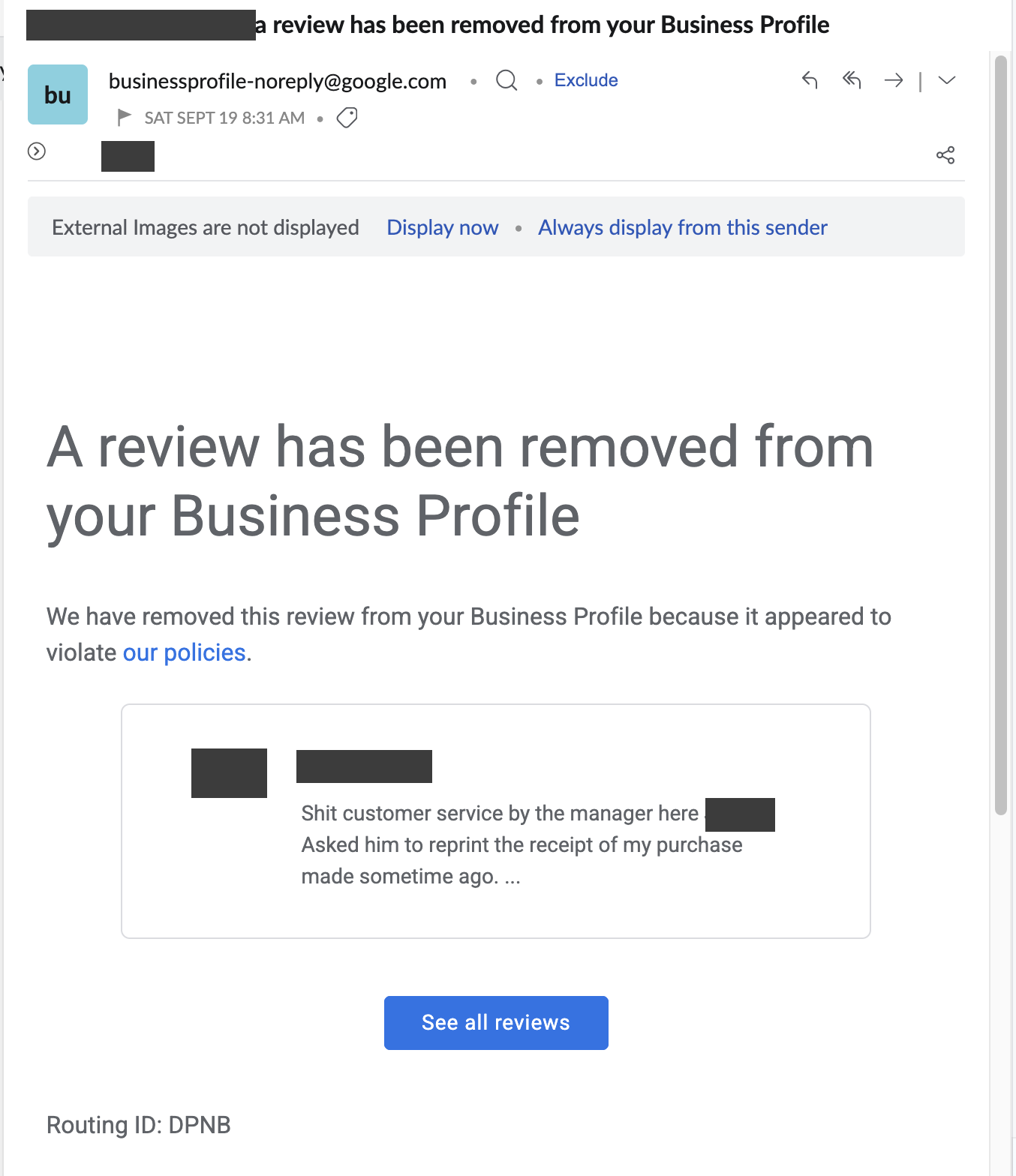
The decision: "A review has been removed from your Business Profile".
That is the whole technique in one case. Quote the words, say what kind of words they are, name the rule, and stay out of the argument about what happened. Our guide to appealing a Google review decision covers the form itself.
If it stays: reply without repeating the name
Plenty of reviews that name staff will stay up, because they describe how the reviewer was treated. The reply matters more than usual here, because your employee will read it too.
Leave the staff member's name out of your reply, even though the reviewer used it. Repeating it puts their name next to the criticism a second time, in your voice. Acknowledge what the customer experienced, say you have spoken with the team, and give a direct way to reach you. Do not defend the employee point by point in public; that turns one bad review into a thread about them.
We go through this in detail in how to respond to a Google review that names staff. Then look after the person privately. A short word from you that you have read it, you have their back and you are dealing with it matters more to them than anything you post.
When you next read a review that names someone on your team, cover the name and read the rest: if what is left is about the service, reply; if it is about the person, report it today.
Protect your team, word for word
Get the Harassment appeal template we use for attacks on named staff, plus the reply that answers the customer without repeating your employee's name.
Get the Playbook · $99Several locations or a group? Talk to us about a managed service · Popular locations: Sydney · Melbourne · Brisbane · Perth · Adelaide · Gold Coast · all locations