How to Respond When a Google Review Names One of Your Staff
2026-09-24
A review has gone up that names someone on your team, and they have probably seen it already. Before you type anything in the reply box, know that you are dealing with two things at once, and the reply is only one of them.
Two things are happening at once
The first is public. Every future customer who scrolls your reviews will read what the reviewer wrote and what you wrote back. That reply has to do the job every reply does: show the next customer how you behave when something goes wrong.
The second is private. A person who works for you has been named online, under your business, where their friends and family can find it. They will read your reply more closely than any customer will. Our data on reviews that name staff shows how often this happens and what it does to the people involved.
A good response handles both, and it handles them separately.
What the reply must never do
Never repeat the staff member's name. The reviewer put it there once. If you write it again, it appears twice, the second time under your business name. Refer to "our team" or "the person who served you".
Never confirm or deny what they did. Not in public. Confirming ("she should not have said that") hangs your employee out in front of every future customer. Denying ("he would never do that") calls the customer a liar. Either way you are ruling on something you have not finished looking into.
Never throw them under the bus. "That person no longer works here" or "they have been spoken to and disciplined" is not something to announce, even when it is true. It tells your team what happens to them when a customer complains, and it tells readers you manage by public example.
Never defend them line by line. Loyalty is a good instinct and the wrong reply. A point-by-point rebuttal turns one customer's complaint into an argument between the business and the customer, with your staff member standing in the middle of it.
What the reply does instead
It makes three points, briefly and in your own words.
- That treatment is not what we expect. You acknowledge how the customer was made to feel, without ruling on exactly what happened.
- It has been raised internally. Enough to show you took it seriously, with no detail on what was said or what followed.
- Contact me directly. A named person (you, not the staff member) and an email or phone number that a person answers.
Here is a fragment, for an invented café:
Being made to feel rushed out the door is not how we want anyone to leave, and I have raised it with the team. I would like to hear the rest from you directly, so please email me at the address below.
Notice what it leaves out: the name, the verdict and the consequence. Every reader can see the complaint was heard, and nobody on your team has been exposed. The full reply for this situation, and for the eight other situations owners face most, is in The Google Review Removal Playbook, and the nine reply situations post explains what each one has to do.
Two variations come up often. If the person named is you, the owner, the same rules apply: do not repeat your own name back, do not defend yourself line by line, and sign off simply. If the person named has since left, say nothing about it. "They no longer work here" still reads as blame, and it invites the reviewer to update the review to say they are glad. The reply is about the customer's experience, not the employee's career.
The conversation with your staff member
Have it before you post the reply, or at least the same day. Show them the review and the reply you intend to post, so nothing reaches them second-hand.
Then listen. Ask what happened, not whether it happened. You may learn the customer has a point, in which case you deal with it the way you would deal with any service problem: privately. You may learn the account is wrong, in which case your public reply still does not say so.
Either way, tell them two things plainly. Their name will not appear in your reply. And if the review goes beyond describing the service and starts attacking them as a person, you will report it. Then do.
When the review stops describing service and starts attacking the person
Naming a staff member is allowed. A reviewer can write that a named person was rude, slow or unhelpful, because that describes the service they received, and those reviews stay up.
The line is crossed when the review stops describing what the person did and goes after who they are: their competence, their character, their looks, their right to have the job. That is a personal attack on an identifiable employee, and it breaks Google's Harassment policy. Combined with swearing aimed at them, it is one of the strongest everyday cases for removal there is. That calls for a report, and if the report comes back "no policy violation", an appeal. Removing a review that attacks an employee walks through both.
A review we had removed shows where the line sits. It named a manager, Dylan, and did not stop at describing a bad interaction. It said he claimed to be the manager and should not be, said he knew nothing about customer service, and swore at him by name more than once. The first report came back with no policy violation. The appeal quoted the reviewer's own words aimed at him, named the Harassment policy, said the review had moved from feedback on the business to a personal attack on an employee, and did not argue about what happened on the day. The review was removed.
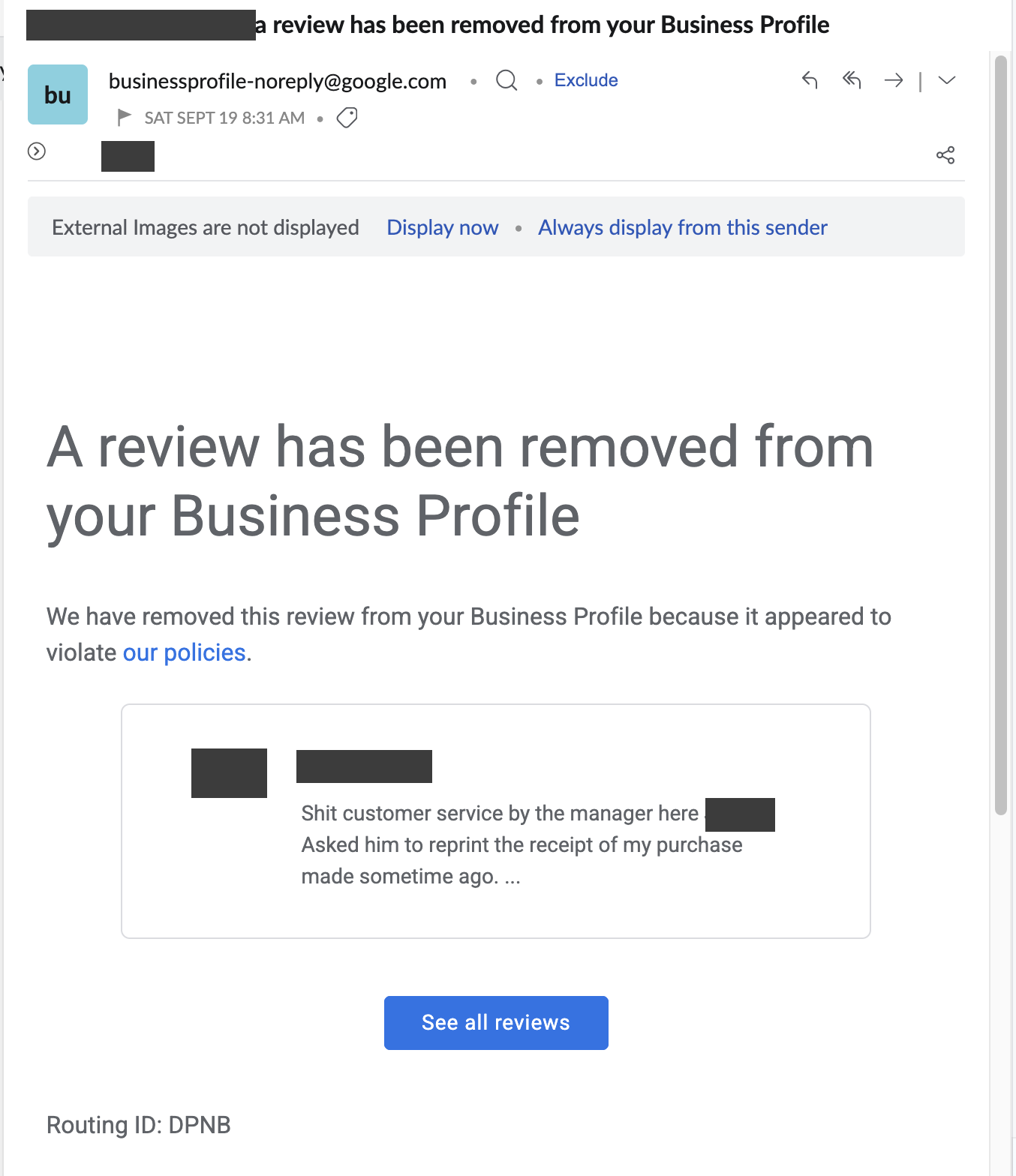
Google's decision email on the named-manager review.
Set that beside "the manager was rude and unhelpful" and you have the difference: one describes a visit, the other goes after a person. Owners get less protection than staff here, because a reviewer is given much more room to criticise the owner or public face of a business than a junior employee.
While the report and any appeal run, the public reply still goes up. It does not mention the report. If the review comes down, the reply goes with it.
When the staff member wants to reply themselves
They will want to, and the answer is no.
A reply from the person named turns a complaint into a personal exchange, in public. The reviewer now has someone to answer back to, and readers see an argument instead of a business handling a problem. Replies come from the business account, written by the owner or manager, and signed with that person's name.
The same goes for the quieter versions. Your staff member should not post a review of their own to balance things out, and neither should their friends or family. Reviews from people connected to the business are a conflict of interest, and they tend to draw exactly the scrutiny you do not want on your profile.
What your staff member can do is tell you everything they remember, so your reply and any report are accurate. That is the most useful thing they can contribute.
If you have several of these to answer, or a backlog of other negative reviews waiting, the Response Pack writes them for you: a reply for each of your 25 most recent negative reviews, in your voice, delivered within 2 business days, sold as a bundle with the playbook. None of them repeats a staff member's name.
Your staff member will read the reply before any customer does, so write it for them as well.
Protect your team and your profile
The staff reply wording, the Harassment appeal approach that removed our named-manager review, and every step to file it yourself.
Get the Playbook · $99Several locations or a group? Talk to us about a managed service · Popular locations: Sydney · Melbourne · Brisbane · Perth · Adelaide · Gold Coast · all locations