DIY Google Review Removal vs Hiring an Agency: An Honest Comparison
2026-09-24
You have a few negative Google reviews you are fairly sure should not be there, and two ways to deal with them: file them yourself, or pay someone to do it. Both work. Both have a point where they stop working. The trick is knowing which point you are closer to.
We sit on both sides of this. We sell a do-it-yourself method, and we run a managed service for groups, filing reports and appeals for clients every week. So here is the comparison as we see it, including the parts that do not flatter either option.
The comparison at a glance
| Doing it yourself | Hiring an agency | |
|---|---|---|
| Cost | Reporting is free; the playbook is $99 once | Many charge $500 or more per review, often unpublished; some take a deposit or a retainer |
| Time to first report | Tonight | After the enquiry, the quote, the agreement and the access |
| Account access | Stays with you | They need manager access to use the owner's tool |
| Tools used | The Reviews Management Tool, report and appeal | The same tools |
| Reviews that stay | You write the replies | Often not included, so ask |
| Google's decision | Nobody can promise it | Nobody can promise it |
The last two rows matter more than the first two. We come back to them below.
Cost and time to the first report
Reporting a review costs nothing. What the do-it-yourself route really costs is your time and the risk of getting the wording wrong. That risk is real: each review gets one appeal, and the decision on it is final. A careless first attempt uses up the best chance the review had.
An agency charges for removing that risk. Many services charge $500 or more per review, and plenty do not publish a price until after a sales call. Some hold a deposit, and some run a monthly retainer. For one location with three or four problem reviews, that adds up quickly. For a group, a retainer can make more sense than paying review by review, because it usually covers more than removal. If a provider offers "no win, no fee", read what no win, no fee review removal actually means before you sign.
On speed, doing it yourself wins the first round. Once you know the screens, a report takes about two minutes, so the first one can be in tonight. With an agency there is an enquiry, a quote, an agreement and the access to set up first.
After the report, nobody is faster. Every report joins the same queue at Google, whoever files it, and shows "Decision pending" until someone at Google looks at it.
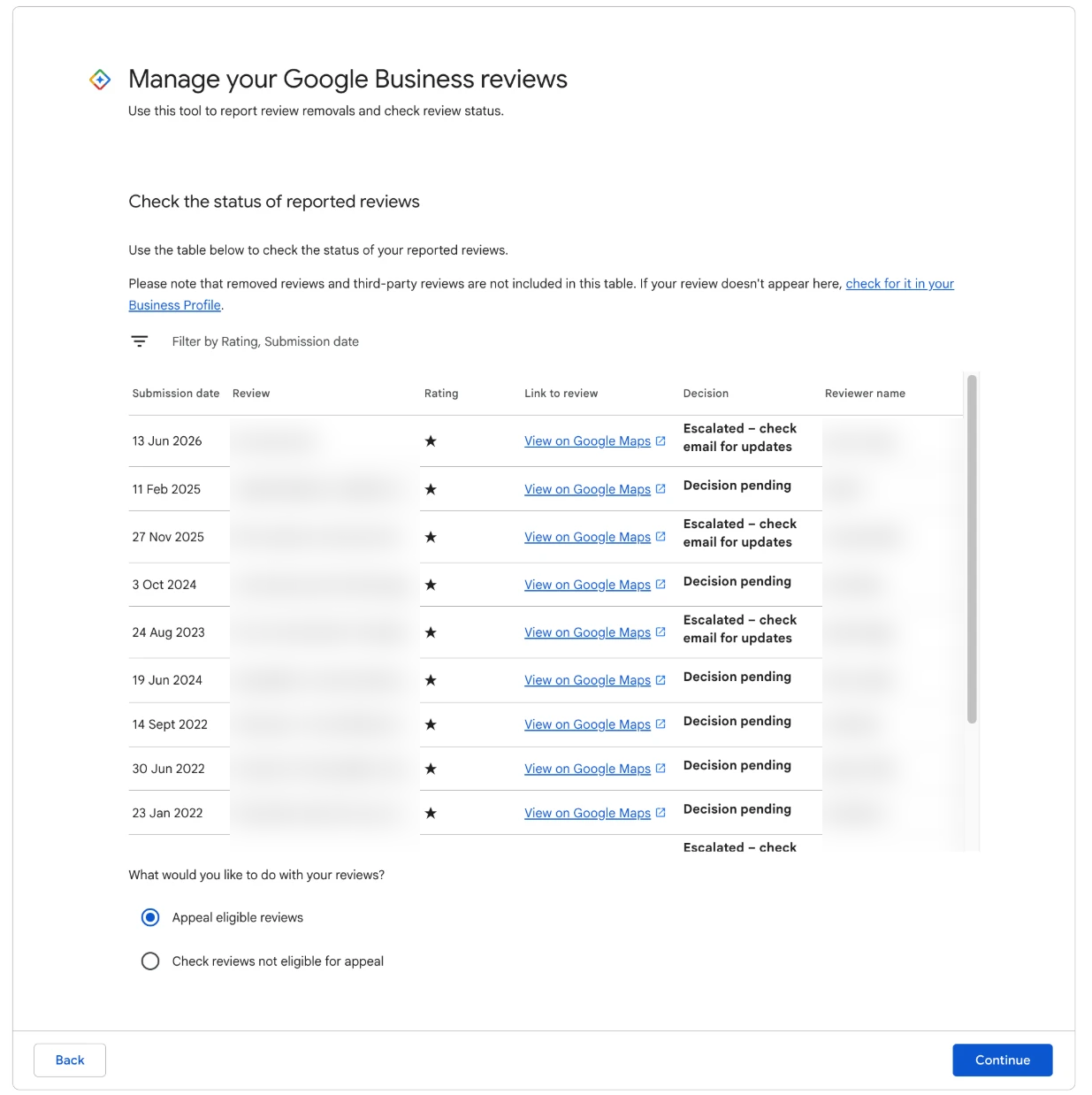
The same status list, whether you file or an agency does. There is no faster lane.
If you are already waiting, how long a Google review report takes covers what the statuses mean and when to act.
Who holds the keys to your profile
This is the row most owners never think about. The Reviews Management Tool, where reports are tracked and appeals are lodged, only works for accounts that own or manage the Business Profile. So an agency has two options: you add them as a manager, or they file from the public report flag, which has no status screen and no appeal.
Adding a manager is normal and you can remove them later. But know what it means:
- A manager can edit your profile and reply to reviews, and those replies appear under your business name.
- Google emails its decisions to the account that reported. If the agency files, the "removed" and "no policy violation" emails go to them, not you. Ask how you will see them.
- Access should end when the work does. Put a note in your calendar to check your managers list.
If you do it yourself, none of this arises. The only account on your profile stays yours.
The reviews that stay are the bigger job
Our research found that about one in seven negative Google reviews breaks Google's own rules. Whoever you hire, the other six are from real customers describing real visits, and they stay.
That is where the reply does its work. People deciding whether to call you read the bad reviews to see what goes wrong and how you behave when it does. A calm, specific reply under a harsh review often does more for you than the review does against you, and it works the same day.
Some removal services price the removal and nothing else, so the reviews with no case get no attention at all. If you hire someone, ask whether replies are included. If you do it yourself, the negative review reply templates post shows what a good reply does, and The Google Review Removal Playbook has nine reply templates, one for each common type of complaint.
Where doing it yourself falls down
The method is learnable. The owner is not always in a state to run it. The do-it-yourself route struggles in four places.
- An owner who cannot read the review calmly. The appeal is judged on the review's words and the rule they break. Owners who are angry write about what really happened in the shop, the refund, the customer's history. All of that is beside the point, and it buries the one sentence that matters. The same anger shows in the reply.
- Forty reviews to work through. Sorting forty negative reviews into "has a case" and "reply only" takes an evening or two with a method, and far longer without one. Across several profiles, it becomes a job.
- Picking the wrong reason. The report reasons differ by screen, and a report filed under a reason that does not fit the breach is easy to decline. Our guide to reporting as the business owner covers both routes.
- Giving up at the first "no". A declined report is the step that opens the appeal, not the end of the case. Owners who stop there leave the best stage unused.
If the forty reviews are the sticking point, the playbook's Response Pack writes the replies for you. If it is forty reviews across eight locations, that is what our managed service is for: tell us about the group.
Where an agency falls down
Agencies have their own weak spots, and they are worth weighing before you pay a deposit.
- Price against the easy wins. Some reviews come down at the first report. You could have filed those in two minutes. At $500 or more per review, the easiest removals can be the most expensive part of the bill.
- Money up front. A deposit or a retainer is paid before Google has decided anything. Ask exactly when it is refunded.
- The same tools, the same faults. Since July 2026 the appeal step often shows "Error accessing the workflow. Please escalate the issue." Agencies hit it too. It is a fault on Google's side, and the workaround (come back later, try a private window, one review at a time) is the same for everyone.
- Less visibility. Decision emails go to whoever filed. Unless the agency shares them, you learn less about your own profile than you would by doing it yourself.
- Narrow scope. A removal-only service leaves the reviews that stay unanswered, and those are most of them.
None of this makes an agency a bad choice. It makes the questions you ask before you sign important. If the weak spots outweigh the strengths for your profile, the alternative to a removal agency sets out what you would do instead.
What nobody can promise, either way
Google decides whether a review comes down. Not the owner, not an agency, not us. A provider who promises a result is promising something they do not control.
What either route can do is put the strongest case in front of Google. That means quoting the exact words that break the rule, naming the policy they break, and leaving everything else out. It is the same case whether you file it or someone else does, and how to appeal a Google review decision shows where it goes.
So the real comparison is simple. If you have one profile and can read your reviews calmly, the case is yours to build. If you have ten profiles, or you cannot face the reviews, pay someone to build it, and ask them which of your reviews have no case before they start.
Doing it yourself? Start with the method
See which of your reviews have a case, report them the right way, and know exactly what to write when a report is declined.
Get the Playbook · $99Several locations or a group? Talk to us about a managed service · Popular locations: Sydney · Melbourne · Brisbane · Perth · Adelaide · Gold Coast · all locations