The Alternative to a Google Review Removal Agency: Do What They Do, Yourself
2026-09-24
You have a quote from a review removal agency open in another tab, or you are about to ask for one, and the number looks bigger than the problem feels. Before you sign, it helps to know exactly what that money buys, because very little of it is access to anything you do not already have.
We work in this industry ourselves. We file reports and appeals for clients every week, and we have read more than 900 negative Google reviews across 54 businesses. So this is the view from inside: what an agency does, what you are paying for, what you can use instead, and when paying someone is still the right call.
What a review removal agency actually does
Take away the sales page and the work is three steps, all of them carried out in Google's own screens.
- Read your negative reviews and pick the ones that break a rule. Google removes words that break its content rules, not reviews that are unfair. A review from a real customer describing a real visit stays, however harsh it is. The skill is finding the reviews where the writer crossed a line: a named employee torn apart, "they are scammers" stated as fact, a reviewer admitting in their own words that they never came in.
- Report each one through the Reviews Management Tool. This is Google's free workflow for Business Profile owners and managers. It lists every review with a Report link, shows the status of each report, and is the only place an appeal can be lodged.
- Appeal the ones that come back declined. When a report returns "Report reviewed, no policy violation", that review becomes eligible for one appeal. The appeal form is the first place anyone gets to explain in writing why the words break a rule, and it is where most of our cases are won.
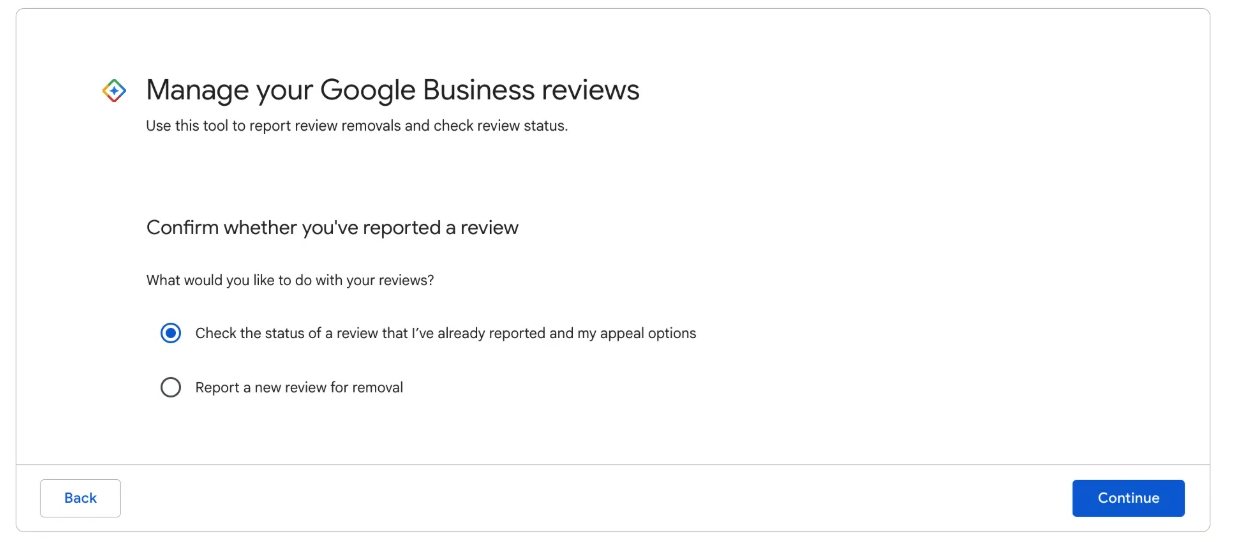
The owner's tool. An agency working on your profile uses this same screen.
There is no back channel. Nobody at an agency has a direct line into Google that you lack. In fact, to use the tool at all, an agency has to be added as a manager on your Business Profile, because the tool only works for accounts that own or manage the profile. Without that access they are limited to the public report flag, which has no status screen and no appeal. If you have never opened the tool, our walkthrough of the Reviews Management Tool shows every screen.
What you are really paying for
If the tools are free and open to you, the fee buys two things.
Their time. Reading every negative review properly, keeping a record of what was filed and when, checking statuses, and coming back when the appeal screen shows "Error accessing the workflow. Please escalate the issue." That error has been common since July 2026. It is a fault on Google's side, and agencies hit it too. For a group with ten profiles, the hours add up, and buying them is sensible.
Their knowledge of the wording. This is the valuable part. Most owners who try it alone pick a report reason at random, get declined, and stop. An experienced filer knows which reason fits which breach, and knows what a winning appeal says. Just as important, they know what it leaves out: the backstory, the refund dispute, the fact that this customer was never happy. The appeal is judged on the review's words and the rule they break, and nothing else. We cover the thinking in what to write in a Google review appeal.
What you are not buying is a better decision than the same case would get from you. Google weighs the review the same way whoever files it, and nobody can promise what it decides.
Then there is the price. Many services charge $500 or more per review, and many do not publish a price at all, so you find out after a sales call. Some hold a deposit or run a monthly retainer. None of that is sinister: skilled time costs money. It just changes the sums for a business with three bad reviews. We set the two routes side by side in DIY Google review removal vs hiring an agency.
What the playbook gives you instead
The knowledge part can be taught, so we wrote it down. The Google Review Removal Playbook is the method we use for clients, as a 42-page PDF, for $99 once. Inside:
- The 12 breaches Google acts on, each with examples of what qualifies and what only looks similar
- Both reporting routes, step by step: the Reviews Management Tool, and the report icon in the business panel on Google Search for the odd review that does not appear in the tool
- 12 copy-and-paste appeal templates, one for each breach, so the argument is built before you open the form
- 9 reply templates for the reviews that stay
- A tracker, so you know what you filed, when, and what came back
The first pass takes about an hour. After that it is minutes a week. It covers every review on every profile you own, and the only account with manager access to your profile stays yours.
It does not replace judgement. You still have to read each review calmly and accept that most of them describe a real visit, which is exactly what our research found: about one in seven negative Google reviews breaks Google's own rules. What the playbook replaces is guessing. When you reach the appeal form, the exact wording for your breach is already written, and you fill in the review's own words.
Who should still hire someone
We sell the do-it-yourself method and we run a managed service, so we have no reason to pretend one suits everybody. Paying someone is the better choice when:
- You run several locations or a group. Ten profiles, each with its own reviews, reports and appeal statuses, is a part-time job. A managed service covers monitoring, reports, appeals and replies across all of them, with one person accountable for the lot.
- You are under active attack. When a profile takes a wave of one-star reviews in a few days from people who were never customers, speed and volume matter more than cost. Our post on Google review bombing covers the first moves.
- You cannot read the reviews calmly. If a review about your family business makes you want to argue, that anger ends up in the appeal and in your reply. Someone at arm's length writes a better case.
- You will not open the tool this month. If that is the true answer, paying someone who will is cheaper than leaving a clear breach on your profile.
If any of those describes you, tell us about the business and we will come back with a plan.
A fair way to decide
| Your situation | Doing it yourself | Hiring someone |
|---|---|---|
| One location, a handful of negative reviews | A good fit: $99 once covers every review | Hard to justify at $500 or more per review |
| One review that is clearly abusive | Report it tonight, appeal if declined | Only if you cannot face it |
| Several locations or a franchise group | Possible, but slow | A managed service fits |
| A sudden wave of reviews from non-customers | Report the clearest ones now | Worth it for the speed |
| Mostly fair complaints about real visits | The replies are the real work, and you can write them | Nobody can remove these for you |
| You cannot read the reviews without getting angry | Risky | Worth it |
Notice the fifth row. For most small businesses, it describes most of the profile. No agency can change that, and the ones worth hiring will tell you so before they take a deposit. The other things a good service should be upfront about are in what review removal companies don't tell you.
What doing it yourself looks like tonight
If the table points you towards doing it yourself, here is the first evening.
- Sign in with the account that owns or manages the profile. Nothing works from a personal account that is not on the profile.
- Sort your reviews by lowest rating and read each one for its words, not its story. You are looking for a line that was crossed, not a complaint you disagree with. Our guide to Google's review policies is a good first filter.
- Take a screenshot of each review you plan to report, so you still have the words if the reviewer edits them.
- Report the strongest ones first, from the Reviews Management Tool, choosing the reason that matches the breach. How to report a Google review as the business owner walks through both routes.
- Reply under the reviews that will stay. A calm, specific reply works the same day, and if a reported review comes down, the reply goes with it. Our negative review reply templates post shows what a good one does.
Decisions arrive by email to the account that reported, so check your spam folder. And if a "no policy violation" email lands next week, file it under progress: that is the day the appeal opens.
Do what the agencies do, for $99
The same method we use for clients: the 12 breaches, both reporting routes and an appeal template for each, for every review on every profile you own.
Get the Playbook · $99Several locations or a group? Talk to us about a managed service · Popular locations: Sydney · Melbourne · Brisbane · Perth · Adelaide · Gold Coast · all locations