What Review Removal Companies Don't Tell You (From People Who Do the Work)
2026-09-24
You are close to paying someone to remove a Google review, and the sales page tells you plenty about what they do. It says less about what they cannot do. None of it is hidden, exactly. It is just not the part that sells.
We are a review removal service ourselves. We file reports and appeals for clients every week, and we have read more than 900 negative Google reviews across 54 businesses. Nothing below makes hiring a service a bad idea. It makes you a better buyer, and it may save you from paying for something you could do yourself.
1. They use the same Google tools you already have
Every legitimate removal service works through Google's own reporting screens. There is no private portal for agencies and no contact at Google who takes their calls.
The main tool is the Reviews Management Tool, Google's free workflow for Business Profile owners and managers. It lists every review on your profile with a Report link beside it, tracks the status of every report, and is the only place an appeal can be lodged. When you report from it, you choose from the same list of reasons any agency sees.
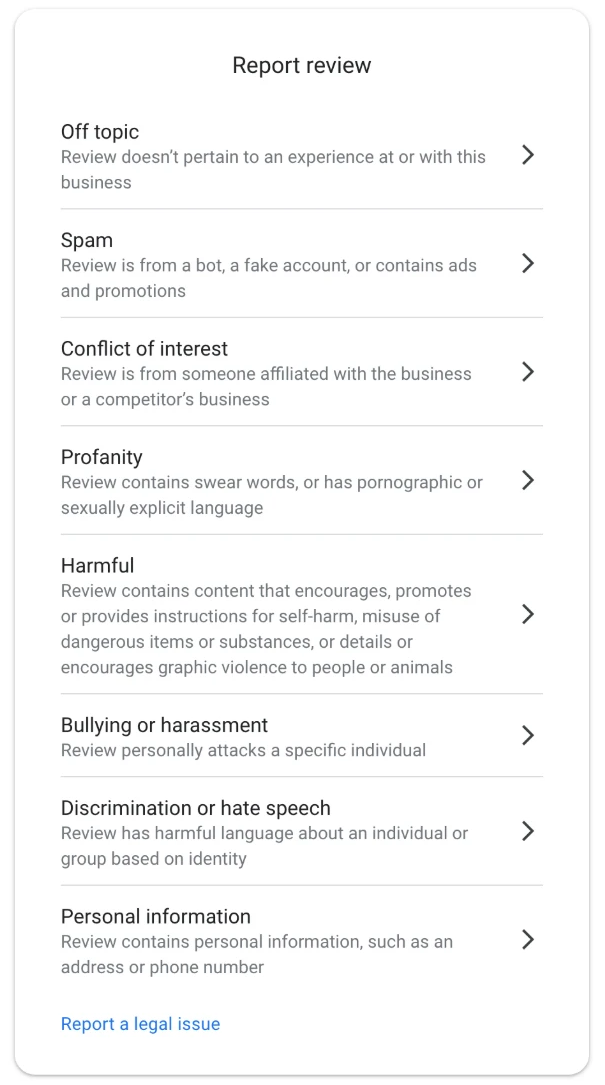
The reasons an owner sees. An agency filing on your profile sees exactly the same dialog.
In fact, the tool only works for accounts that own or manage the profile, so an agency that wants to use it has to be added as a manager on yours. What a good service brings is not access. It is knowing which reason fits which review, and what to write when a report is declined. Our walkthrough of the Reviews Management Tool shows every screen.
2. Nobody can promise what Google decides
Google makes the decision on every review. The service does not, the owner does not, and a confident tone on a sales call does not change that.
What a service can do is build the strongest case. When a report comes back "Report reviewed, no policy violation", the review becomes eligible for one appeal, and the appeal is where a well-built argument wins. We had a review that swore repeatedly at a named manager, Dylan, and questioned his right to the job. The first report was declined. The appeal quoted the reviewer's own words, named the Harassment policy, and left everything else out.
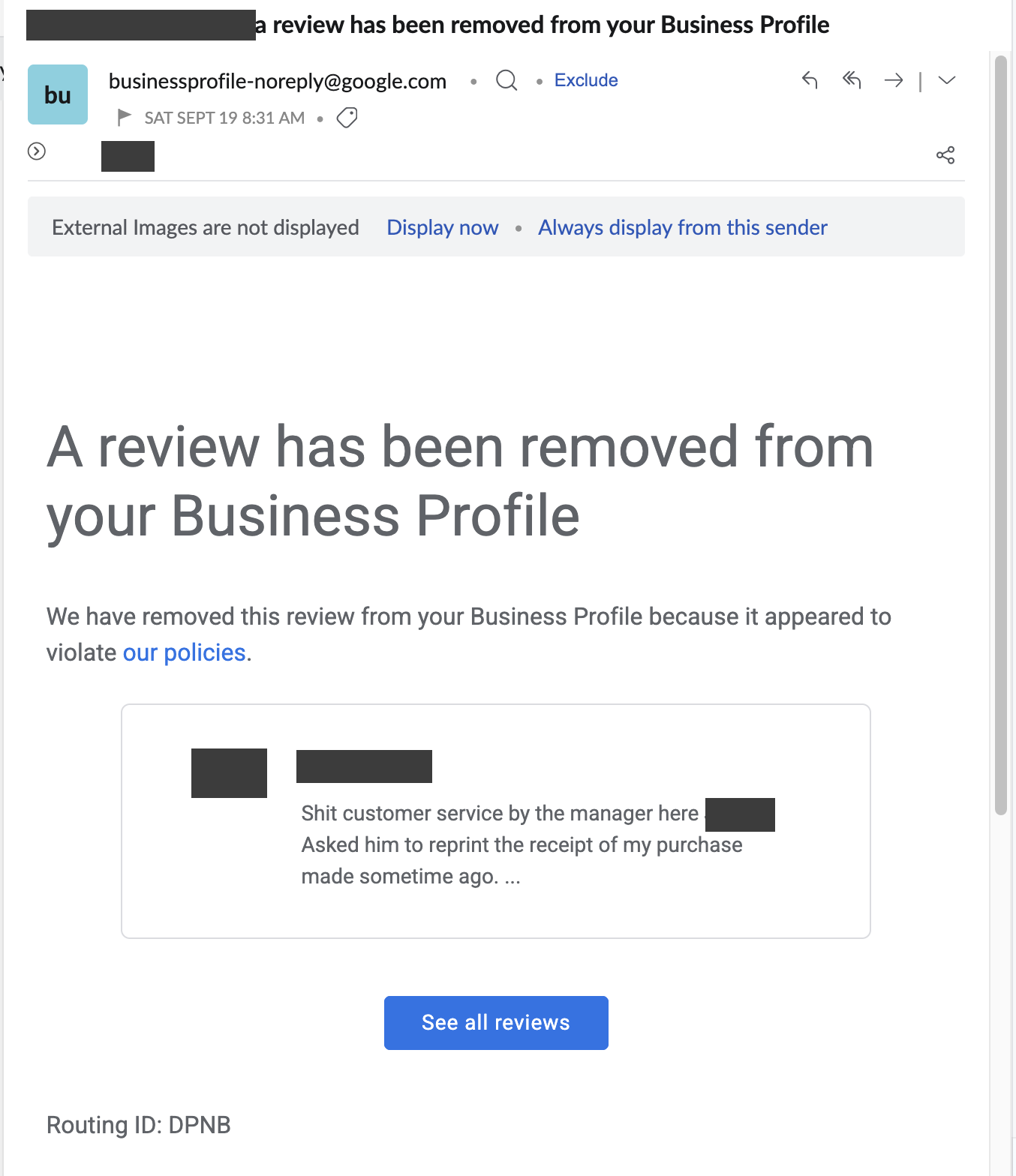
A win arrives as an email after Google decides. Nobody can send it to you in advance.
A service that says "we will get it removed" is making a promise it does not control. A service that says "this review has a strong case under Harassment, and here is why" is telling you something useful. Listen for the difference. Our post on removing a review that attacks an employee explains why that case was strong.
3. "No win, no fee" often comes with a deposit or a retainer
"No win, no fee" is a fair model in its plain form: you pay for each review that comes down, and nothing for the ones that stay. The fine print is where it varies. Some services hold a deposit before they start. Some set a minimum. Some run a monthly retainer alongside the per-removal fee, or instead of it.
Price is the other quiet part. Many services charge $500 or more per review, and many do not publish a price at all, so the first number you hear comes after a call about how much the review is hurting you.
None of that is wrong in itself. Skilled time costs money, and a retainer suits a group that needs ongoing work. But you should know which model you are signing before you sign it. We set out the questions to ask in what no win, no fee review removal actually means.
4. Most of your negative reviews are from real customers, and they will stay
Google removes words that break its content rules. It does not remove reviews for being unfair, exaggerated or one-sided. A review from a real customer describing a real visit stays, however harsh it is, and whoever you hire.
Our own research found that about one in seven negative Google reviews breaks Google's own rules. The other six are complaints about real visits, and no service can move them. The line is often narrower than owners expect:
- "They are scammers", stated as fact, is a Misrepresentation case. "I felt ripped off" is an opinion, and it is allowed.
- A threat of harm is Harassment. A threat to sue, to complain to a regulator, or to "tell everyone" is not.
- Naming the owner or a staff member is allowed. A personal attack on that named person is the breach.
A good service will tell you which of your reviews have no case, and it will say so before you pay. If a service looks at your profile and finds every review removable, you are hearing a sales pitch, not an assessment. For the reviews that will stay, what to do about an unfair Google review is a more useful read than any quote.
5. The reply under a review that stays is worth more than the removal attempt
People deciding whether to call you read your worst reviews to find out two things: what goes wrong, and how you behave when it does. The review answers the first question. Your reply answers the second, and it is the only part of the page you control.
A calm, specific reply under a harsh review often does more for you than the review does against you. It works the same day you post it, with no queue and no decision to wait for. And if the review is later removed, the reply goes with it, so there is no cost to replying while a report is pending.
A good reply is written for the next customer, not the reviewer. It picks out one specific thing from the review, says what you have done or what your normal practice is, and gives a name and a direct way to reach you. It does not repeat the accusation and does not mention reports or policies, which read as threats. Something as plain as "I am sorry the wait spoiled your morning; we have added a second person on the coffee machine at weekends" does more than a paragraph of defence.
Some removal services price removal and nothing else, which leaves most of your negative reviews without a reply. Our negative review reply templates post shows what the reply should do for each common type of complaint.
6. The method is learnable in an evening
This is the one the industry is least keen to say out loud. The core of the work fits in one sentence: find the exact words, name the rule they break, and put the two side by side. Everything else is doing that carefully, review by review.
What takes practice is the detail. Which of the twelve breaches a review falls under. Which report reason matches it on which screen. What an appeal says, and what it leaves out, such as the backstory, the refund and the customer's history. That detail is what we wrote down in The Google Review Removal Playbook: the method we use for clients, with an appeal template for each breach, for $99 once. The first pass through your reviews takes about an hour.
A service still earns its fee in some situations. A group with many locations, a profile under a sudden attack from people who were never customers, or an owner who cannot read the reviews without wanting to argue: in those cases a managed service is the right call, and we run one. If you are still weighing it up, DIY Google review removal vs hiring an agency compares the two routes row by row.
For one profile and a handful of reviews, open the Reviews Management Tool tonight, report the one review that clearly crosses a line, and reply to the rest before you go to bed.
The method, without the sales call
Find the exact words, name the rule they break, and build your appeal from a template for each breach. $99 once, learnable in an evening.
Get the Playbook · $99Several locations or a group? Talk to us about a managed service · Popular locations: Sydney · Melbourne · Brisbane · Perth · Adelaide · Gold Coast · all locations