Real Estate Agents: The Google Review From Someone Who Was Never Your Client
2026-09-24
A one-star review has landed on your agency's profile, and you know the person was never your client. They were an underbidder at Saturday's auction, a tenant in one of the properties you manage, a buyer on the other side of a sale you ran for the vendor, or the neighbour whose driveway was blocked during an open home. You acted for someone else entirely, and now your appraisal-ready profile carries their verdict.
The instinct is to report it on the grounds that they were never a client. That is the report most likely to fail, and the reason is worth understanding before you spend your one appeal on it.
Everyone who deals with an agency can review it
Reviews are meant to describe a real experience with the business, and an experience is broader than a client relationship. A buyer who inspected a property, registered to bid, made an offer or rang your sales agent three times has dealt with your agency. So has a tenant who lodged a maintenance request, an applicant who was knocked back, and a neighbour who was door-knocked for an appraisal.
Your duty was to the vendor or the landlord, and doing that job well is often exactly what upset them. None of that matters to Google. The question is not whose side you were on, but whether the person had contact with your business. For almost everyone who reviews an agency, they did.
This is where agencies differ most from other businesses. A café's "never a customer" reviewer usually had no contact at all. An agency's usually had plenty, just not as a client. The patterns we see:
- The underbidder. Missed out at auction or had an offer declined, and blames the agent rather than the market or the vendor.
- The buyer on the other side. Bought the property and felt pushed on price, or felt information was held back.
- The tenant. Angry about a repair, a rent increase or the bond, and reviewing the agency because the landlord has no profile to review.
- The rejected applicant. Applied for a rental, did not get it, and suspects the process was unfair.
- The appraisal that did not list. A homeowner who got your appraisal, listed with someone else, and wants to say why.
- The neighbour. Unhappy about open-home parking, signboards or letterbox drops.
All of these count as an experience with your business, so "not my client" is not a breach on its own. Check them for the other breaches instead: a label like "crooks", swearing at a named agent, or a personal attack on a property manager all stand on their own, whoever the reviewer was.
When the reviewer admits it in their own words
There is one version of "never a client" that is a removal case: the reviewer says so in the review. Not you, from your records. Them, on the page.
Wording that qualifies (invented examples):
- "Haven't dealt with this agency myself, but my sister rents through them and they're a joke."
- "Never used them and never will after what I've heard about how they treat tenants."
In both, the reviewer has admitted there was no experience of their own. That falls under Google's Fake Engagement policy, and the admission is the whole case.
Wording that only looks similar:
- "I'm not their client, they work for the vendor, and they made that very clear at the auction." Not a client, but there was an experience: the auction.
- "Worst property managers in the suburb." You cannot place the name, but the review claims an experience.
Report the qualifying version from Google's Reviews Management Tool, signed in to the account that owns or manages your Business Profile, and pick Spam. From the public listing or the Maps app, pick Low quality information. If the report comes back "Report reviewed, no policy violation" and the review is eligible for appeal, name Fake Engagement as the policy and quote the admission word for word. Leave out your CRM, your tenancy records and your other reviews. Our post on reviews from people who were never customers walks through this case in full.
The rival agent and the former staff member
Real estate is local and competitive, and agents move between agencies. Two conflict-of-interest situations come up more often in this industry than most: a review from someone at a competing agency, and a review from a former agent or property manager, sometimes one who now works for a rival down the road.
Both are breaches. Neither can be reported on suspicion. A review that appears the week after you won a listing against another agency is a sign, not proof. What counts is evidence that connects the reviewer's Google account to the competing agency or to your own employment records, in a way a stranger could check:
- The reviewer's public Google profile. Their name, photo and other reviews. A profile that rates one agency five stars and every other agency in the area one star tells a story.
- A matching name or photo on the rival agency's team page, or on the agent profile pages of the property portals.
- Your own employment records for a former staff member, including the date they left.
Screenshot all of it, with the web address visible and the date noted, before you report and before you mention your suspicion to anyone. Then report it as Conflict of interest in the tool. The appeal policy for a proven conflict is Fake Engagement. Our guide to getting a competitor's review removed explains how the evidence reaches Google.
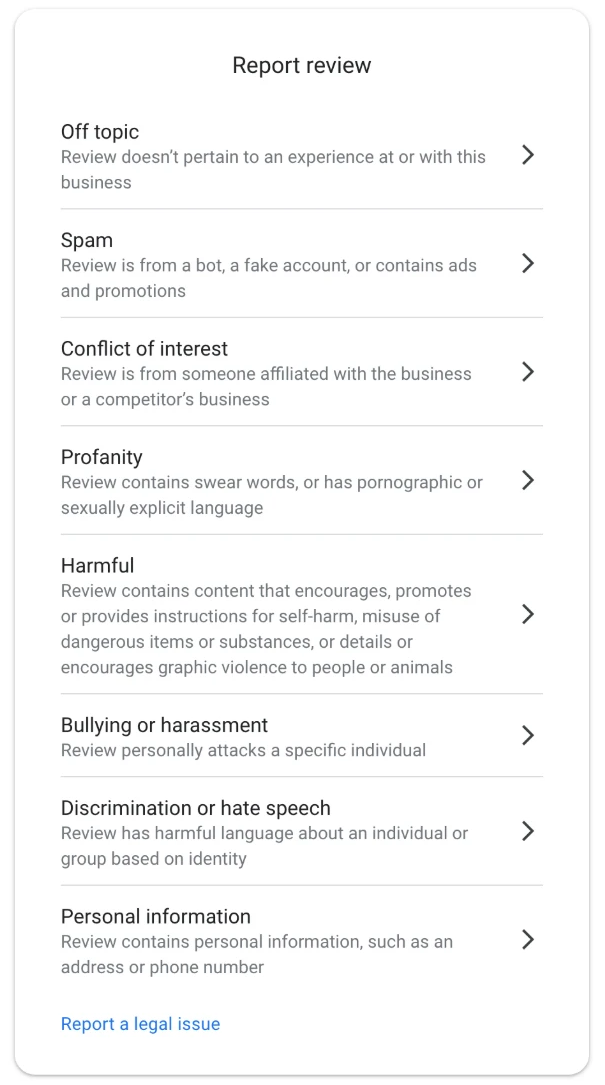
Conflict of interest is only offered inside the tool and on your business panel on Search, not on the public listing.
The wording that ties an admission or a proven conflict to the policy is where these appeals are won, and The Google Review Removal Playbook has the template for each.
The reply for a missed-out buyer
Most reviews from people who were not your client will stay, so the reply does the work. Vendors choosing an agent read these replies closely, because they show how you treat people under pressure.
The reply to an underbidder or an unhappy buyer should:
- Acknowledge the disappointment. Missing out on a home is hard, and saying so costs nothing.
- State your process in one plain sentence. For example, that every offer is presented to the vendor and the vendor decides. That tells every reader how you work without arguing about this sale.
- Keep the sale private. Not the price, not the other offers, not the vendor's circumstances. Your vendor is reading too.
- Avoid "you were never our client". It is true, and it reads as dismissive to every buyer who might one day become a vendor.
- Invite a direct conversation with the agent in charge, by name, with a phone number.
The reply for a tenant
Tenant reviews on a sales-focused profile are the hardest to leave alone, and the easiest to make worse.
Keep every detail of the tenancy out of it: the rent, the bond, arrears, the maintenance request and what the landlord decided. All of it is personal information, some of it belongs to your landlord, and none of it will persuade a reader. Say that you take concerns about a property seriously, give one sentence on how repair requests are handled, and direct them to your property manager or head of property management by name.
A sentence that fits: "Every repair request is passed to the owner the day we receive it, and I would like to talk through where this one stands, so please call me directly." The playbook's reply templates for a disputed account and for a reviewer you do not recognise are the base for both of these replies, adjusted for the privacy of your vendors, landlords and tenants.
What the reply must never do is accuse. "This person is not our tenant" or "this is a fake review" invites an argument you cannot win in public. Our post on how to reply to a fake Google review covers that situation, and our page on Google review removal for real estate agencies covers the other patterns we see on agency profiles.
Before you report the next review from someone you never acted for, find the sentence where they describe dealing with your agency: if there is one, reply; if they say there was none, report it that day.
Handle reviews from people you never represented
Appeal templates for a reviewer's own admission and a proven rival or ex-staff conflict, plus replies for underbidders and tenants that protect your vendors.
Get the Playbook · $99Several locations or a group? Talk to us about a managed service · Popular locations: Sydney · Melbourne · Brisbane · Perth · Adelaide · Gold Coast · all locations