How to Respond to a Google Review From a Former Employee
2026-09-24
You recognise the name on the one-star review. It is someone who used to work for you, and the review is dressed up as a customer complaint, or it is openly about what it was like to work there. You know why they left, and you know the review is not really about your service.
Everything you know is exactly what you cannot say. That is the first thing to get straight before you type a reply.
Why you cannot say what you know
The natural reply writes itself: "This person is a former employee who was let go for..." It feels like the truth, and it would explain everything to readers. It is also the most expensive reply you could post.
Never confirm, in public, that the reviewer worked for you, and never discuss their employment: why it ended, how they performed, what they were paid, what was said in a meeting. Information about someone's employment is not yours to publish, and doing it on your Google profile can expose you under privacy and employment law, and to a defamation claim if anything you say about them turns out to be arguable. If there is a dispute running (an unfair dismissal application, a general protections claim, an underpayment complaint), anything you post can be put in front of the Fair Work Commission or a court.
There is a reputation cost too. Readers do not know the history. What they see is an employer publicly airing a former staff member's record, and they wonder what you would say about them. Any business that fights with its former staff in public looks like a hard place to work, whether or not the review was fair.
The reply that speaks to customers
The reply is not for the former employee, and it is not about them. It is for the next customer, who wants to know one thing: does this review describe what I will experience?
So the reply stays on customer ground. It does not mention employment at all. If the review poses as a customer complaint, the reply can say, truthfully, that you have not been able to match it to a visit or a job, and invite anyone with a concern about your work to contact you directly. If the review is openly about working there, the reply can say briefly that it does not describe a customer's experience, and point readers to the ways you look after customers.
Here is a two-sentence fragment for an invented landscaping business, where the review poses as a customer:
We have not been able to match this review to a job in our records, so I cannot respond to the specifics here. Anyone with a concern about our work is welcome to contact me directly, and I will look into it myself.
Short, true, and nothing a stranger could read as a fight. The reply templates in The Google Review Removal Playbook include the one for a reviewer you cannot match to a visit, which is the one we adapt for this situation.
What the reply must never do
- Never say "former employee", "ex-staff" or "disgruntled". Any of those confirms employment, and "disgruntled" adds a judgement readers will hold against you.
- Never say you know who wrote it. "We know exactly who this is" reads as a threat, and it confirms a connection you have not proved to anyone.
- Never answer their workplace complaints. If the review says staff are underpaid or the roster is unfair, the reply box is not where you defend your employment practices. It turns a customer page into an industrial dispute.
- Never let current staff reply. Not from the business account, and not with reviews of their own to balance it out. Reviews from people connected to the business are a conflict of interest in the other direction, and they draw exactly the scrutiny you do not want.
- Never organise people to report it. One report from you, on the right grounds, is the method. A wave of reports from staff and friends is treated as manipulation.
When it is a report, not just a reply
A review from someone with a personal stake in your business is a conflict of interest, and a current or former employee has that stake. That is one of the breaches Google removes reviews for. The catch is the same as with a competitor: the rule is simple, the evidence is the hard part.
A former employee posing as a customer is a conflict of interest if you can show it. "I am sure it is them" is not enough. What carries it is a connection a stranger could check: the name and photo on the reviewer's Google profile matching your employment records, with the date their employment ended. Our post on removing a review from a competitor walks through what counts as proof, and the same standard applies here.
A review that says in its own words that the writer worked for you is simpler, because the stake is stated in the review. "I worked here for two years and the owner treats everyone like dirt" is not a customer describing a visit.
A review that goes after current staff is worth checking on its own terms. A former colleague naming someone and attacking them personally, or publishing a staff member's phone number or home suburb, may be a Harassment or Personal information case whatever the reviewer's history. See reviews that attack an employee and reviews that publish personal information.
Report from the Reviews Management Tool, signed in to the account that manages your profile. Conflict of interest is one of the reasons it offers. The public listing and the Maps app do not show that option, which is one reason the tool is the better place to file.
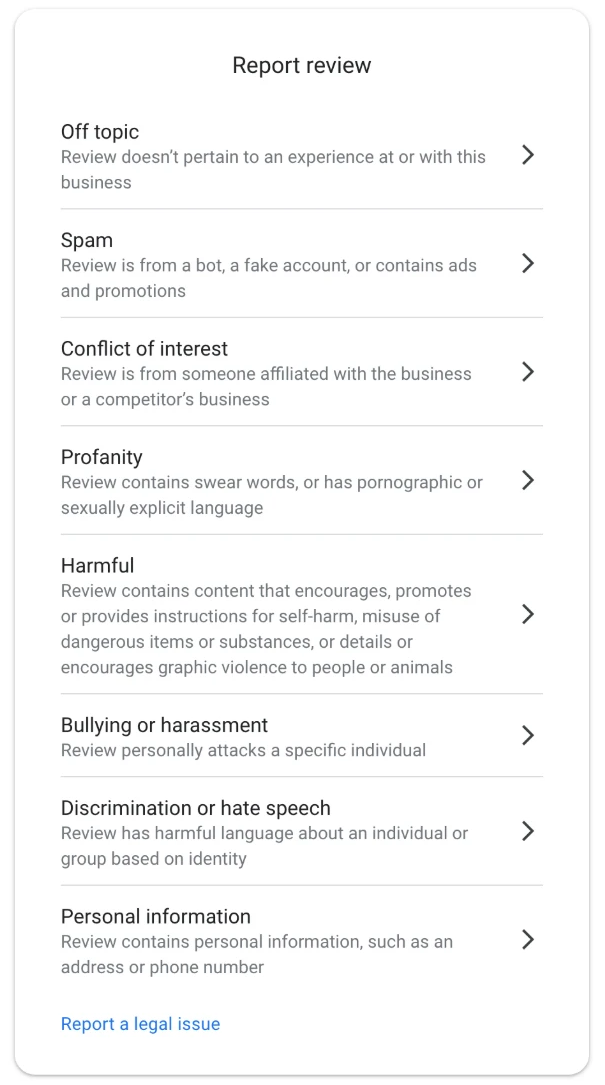
The report reasons in the Reviews Management Tool. Conflict of interest only appears here and in the business panel on Search.
There is no box for evidence at the report stage. If the report comes back "no policy violation", the review becomes eligible for appeal, and that is where your evidence goes in. Our post on ex-employee reviews has more background on why these reviews cause so much damage.
Building the proof without creating a new problem
The evidence for a conflict of interest comes from your employment records, which are exactly the records you should be careful with. Share the minimum.
- Screenshot the reviewer's public profile first: display name, photo, other reviews. Do it before you mention your suspicion to anyone, because names and photos can change in seconds.
- Use only what connects them. Their name, and the fact and date of their employment ending. Not their file, not the reasons they left, not any warnings or performance notes.
- Keep it between you and Google. Evidence attached to an appeal goes to Google, not onto your profile. None of it belongs in the public reply.
The appeal explanation that ties that evidence to the policy has its own template in the playbook, with a worked example of how to describe the attachments in a sentence or two.
When to bring in your lawyer or HR adviser
Most ex-employee reviews need a calm reply and, if you can show the connection, a report. Some need more, and it is worth a call before you post anything when:
- The review alleges something unlawful. Underpayment, unsafe work, harassment or discrimination at work. Those allegations may need to be dealt with as workplace matters in their own right, whatever happens to the review.
- There is a claim already running, or you expect one. What you post, and what you say to the reviewer privately, can matter to it.
- There is a separation agreement. If it contains terms about what either side can say, your adviser can tell you whether they apply. Do not raise it in the reply, and do not message the reviewer about it yourself.
- The review states something false and damaging as fact. That is where the legal route sits, separate from Google's content rules. Our post on Google review defamation in Australia explains when a solicitor and a concerns notice make sense.
- You are tempted to contact the reviewer. A message from a former employer about a review can easily read as pressure. Let an adviser decide whether, and how, it is sent.
If an ex-employee review is one of several unanswered negatives on your profile, the Response Pack writes a reply for each of your 25 most recent negative reviews, in your voice, sold as a bundle with the playbook and delivered within 2 business days. Any review that is also worth reporting comes with a note saying so.
Screenshot the reviewer's profile now, before you do anything else, and write a reply that a customer could read without ever guessing who wrote the review.
Handle the ex-employee review the right way
Get the reply that speaks to customers, not your former staff member, and the conflict of interest appeal template with a worked example of attaching your proof.
Get the Playbook · $99Several locations or a group? Talk to us about a managed service · Popular locations: Sydney · Melbourne · Brisbane · Perth · Adelaide · Gold Coast · all locations