A Google Review Says Your Restaurant Gave Them Food Poisoning. What Stays, What Comes Down, and How to Reply
2026-09-24
A one-star review says someone got sick after eating at your restaurant. It might name a dish and a night, or it might just say your food makes people ill. Either way, it is the review every diner stops at, because nobody wants to book the table that ends with a night on the bathroom floor.
Before you think about Google at all, deal with it as a food safety question. Then read the words closely, because a review about illness can be one of two very different things, and only one of them is worth reporting.
First, check your own kitchen
Whatever you think of the review, find out what you can privately before you touch the reply box.
- Which service and which dish? If the review names a night or a meal, pull the booking, the docket and the kitchen's records for that service: temperature logs, delivery records, who was on the pass.
- Has anyone else said the same? Check your emails, your phone messages and your other review sites for anything from the same service.
- Talk to the kitchen. Not to find someone to blame, but to know whether anything went wrong that day: a fridge that played up, a supplier delivery that arrived warm, a staff member who came in unwell.
If you hear of more than one person unwell after the same service, stop thinking about the review and speak to your local council's environmental health team. That is the right order of priorities, and it is also the only position you can defend in public later.
Most of the time you will find nothing, and you will still not know whether the meal made them ill. Neither will Google. That uncertainty shapes everything that follows.
A first-hand account of being ill stays
"Had the prawn linguine on Saturday night and was sick for two days." That is a diner describing their own experience after a meal at your restaurant. It stays up, and it should.
It stays even if you are confident the cause was something else: the kebab on the way home, a stomach bug going around the office, a meal the day before. You cannot prove any of that, and Google does not referee what happened after someone left your dining room. A review from a real customer describing a real visit is allowed, however much damage it does.
So do not report it hoping for a different answer. Your only appeal on a review is too valuable to spend on an argument about the cause of an illness, and a report built on "we do not believe them" has nothing on the page to point at. The reply is your tool for this one, and it can do more for you than you might think.
A sweeping claim stated as fact is a different review
Some illness reviews do not describe a meal at all. They tell the world what your restaurant is:
- "Their food makes people sick."
- "Everyone I know who has eaten here got food poisoning."
- "Beware. Filthy kitchen." with no visit described anywhere.
- "Never eaten there but my cousin's friend was in hospital after it."
These are not a diner describing their own night. They are sweeping claims about your business, stated as fact, with no experience of their own behind them. That is the version worth a report.
| What the review says | What it is | What to do |
|---|---|---|
| "I ate the chicken on Friday and was ill all weekend" | Their own account of a visit | Reply. It stays. |
| "Their food makes people sick" | A sweeping health claim stated as fact | Free report as Spam |
| "Filthy kitchen, avoid" with no visit described | A bare warning with no experience in it | Free report as Spam or Off topic |
| "Never been, but I heard people got sick" | The reviewer admits they never ate with you | Report as Spam, a stronger case |
The last row deserves a second look. When the reviewer says in their own words that they never ate with you, the review describes no experience at your restaurant, which is a Fake Engagement case. Our post on reviews from people who were never customers covers it.
Watch for mixed reviews. "Had the fish, felt awful the next day, this place makes everyone sick" contains an account of a visit and then a sweeping line. The account stays whatever you do, so treat the review as a reply first and a free report second.
How to report it, including from your phone
Reporting is free, so these sweeping claims are worth two minutes each. The best place to do it is Google's Reviews Management Tool, signed in to the account that owns or manages your Business Profile. Pick Spam for a health claim stated as fact, or Off topic for a bare warning or a rant with no visit in it. Our post on off-topic reviews and rants explains that second category.
Many restaurant owners see a review on their phone in the middle of service and report it there and then from the Maps app. That works, but the list is shorter.
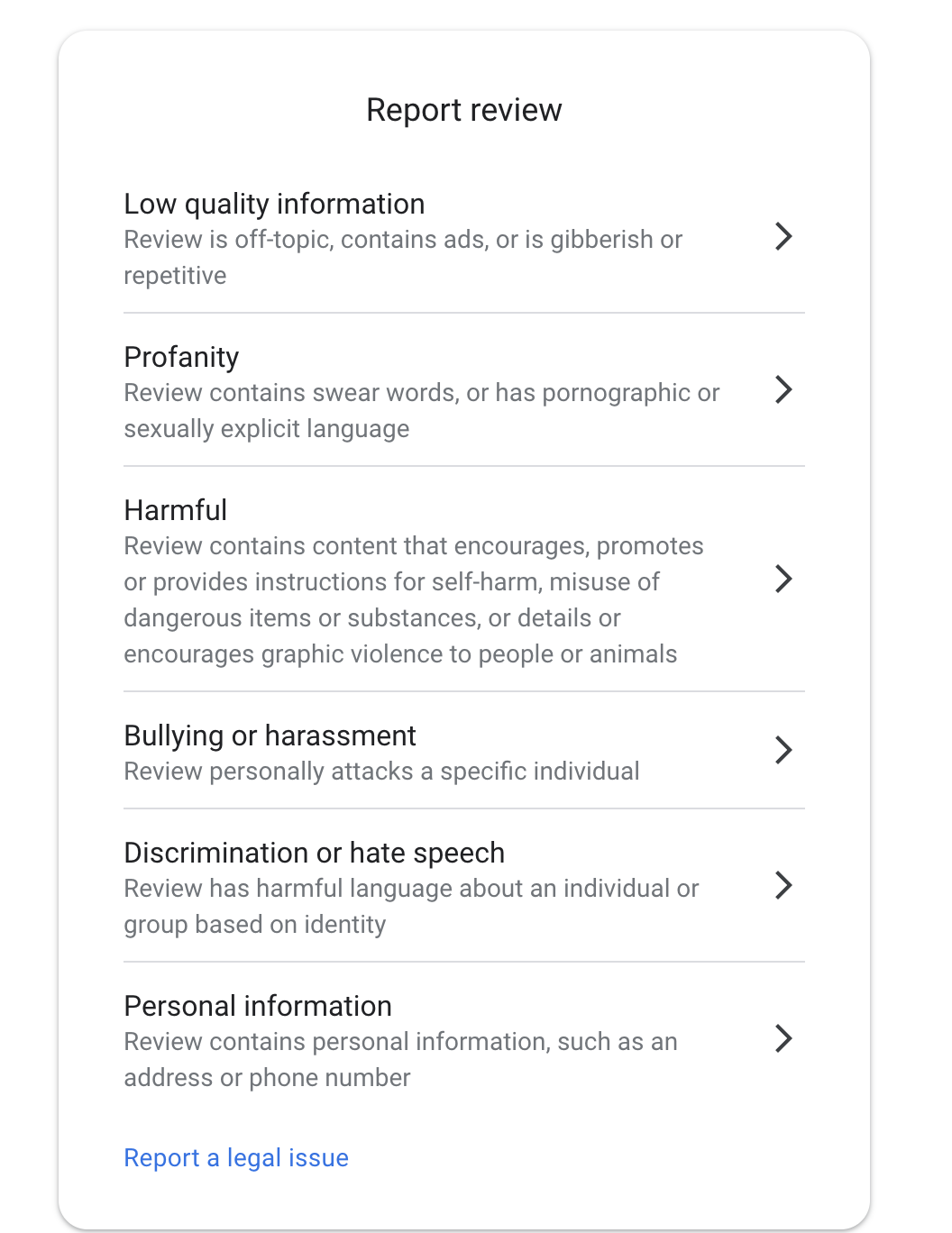
From the public listing or the Maps app, Spam and Off topic are not offered. Pick Low quality information.
If the report comes back "Report reviewed, no policy violation", the tool's status check shows whether the review is eligible for appeal. For a claim stated as fact about your business, the policy to name is Misrepresentation. For a review with no visit described at all, it is Off-topic. Either way the appeal quotes the reviewer's exact words and says what kind of words they are. It does not mention your inspection history, your temperature logs or how long you have been open, because those turn a question about words into a dispute about hygiene. The Google Review Removal Playbook has the appeal wording for both policies.
Be realistic about these. A sweeping health claim is a weaker case than a threat or a personal attack on a named staff member, which is why we treat it as a free shot rather than a certain one. The reply matters just as much.
The reply: take it seriously, every time
Reply to every illness review within a day or two, including the ones you have reported. If a reported review comes down, the reply goes with it. If it stays, you have already answered it.
A good reply to a report of illness does five things:
- Takes it seriously. Sorry to hear they were unwell, full stop. No "but", no qualifiers.
- Never denies it. "Nobody else got sick that night" and "it could not have been our food" both call an unwell person a liar in front of every future diner. Even when you are sure, you do not know, and the next reader can tell the difference.
- Describes your food safety practice in one sentence. What you actually do, such as how deliveries are checked or how the kitchen records temperatures, in plain words. One sentence reads as confident; a paragraph reads as defensive.
- Keeps their health private. Do not repeat their symptoms, the dish they ordered or the night they came in. They chose to share that. You do not need to share it again.
- Invites direct contact. A name, and a phone number or email a person answers, so you can hear the details and look into it properly.
One more rule: leave the health department out of it unless there is something specific and settled to say. "Council inspected us last week and found no issues" is only worth writing if it is true and you can say it plainly. "We have passed every inspection" or "the health department will back us up" invites a question you do not want in public. When in doubt, leave it out.
A sentence that sets the tone: "I am sorry you were unwell, and I would like to look into this properly, so please call me directly on the number below." The playbook's reply template for a complaint about the quality of food is the starting point for this reply, with the food safety sentence added. Our post on how to respond to negative Google reviews covers the general rules.
The reply for the sweeping version is shorter still. Thank them, say you take any report of illness seriously, give your one sentence on practice, and ask them to get in touch with the details of their visit. Every reader can see you asked, and that nobody answered.
If a review says the reviewer is going to report you to the council, answer it the same way. A reviewer taking a concern to a regulator is not a threat of harm, and a calm reply shows that you welcome scrutiny rather than fear it. Our page on Google review removal for restaurants covers the other patterns we see on restaurant profiles.
When the next illness review arrives, check the kitchen before the keyboard: the answer you find there decides both what you report and what you can truthfully say in reply.
Answer illness claims without making it worse
The appeal wording for sweeping health claims, and the reply template for food complaints that takes illness seriously without admitting or denying anything.
Get the Playbook · $99Several locations or a group? Talk to us about a managed service · Popular locations: Sydney · Melbourne · Brisbane · Perth · Adelaide · Gold Coast · all locations