A Google Review That Is Not About a Visit: Rants, Politics and Off-Topic Content
2026-09-24
The review on your profile is not about your business at all. It is about the government, a news story, a sign in your window, the price of petrol or what is wrong with young people today. The reviewer never mentions a meal, a job or a conversation with anyone on your team. They just picked your listing as the place to say it, and gave you one star while they were there.
These reviews can come down. Whether yours will depends on one thing, and it is easy to check.
What the rule covers
Reviews are meant to describe an experience at the business they are posted on. Google's Off-topic policy covers general, political, social or personal commentary that is not about an experience at that place. A rant that uses your listing as a noticeboard is the plainest version of it.
Wording that qualifies (invented examples):
- "Businesses like this are what's wrong with this country. Wake up."
- "Anyone who supports that council decision deserves to go broke."
- "Everything is too expensive these days and nobody cares about the little guy."
None of these describe a visit, a purchase, a quote or a phone call. They are opinions about the world, and your business happens to be where they landed.
The reviewer does not have to be fake for this to apply. Some of these come from people who have been customers at some point. What matters is that the review in front of you describes no experience at your business.
One line about a visit changes everything
This is the test, and it decides the whole case: is there a visit described anywhere in the review?
Wording that only looks similar:
- "Coffee was lukewarm and eight dollars. Thanks, government."
- "Waited half an hour for a table, and the whole place was plastered with political posters."
The first is a complaint about the coffee with a political aside tacked on. The second is a complaint about the wait with a comment about your decor. Both describe a visit, so both stay, however much of the review is taken up with commentary.
Owners find this frustrating, because the political part is often what does the damage, and the visit might be a single throwaway line. But the rule is about content with no experience in it. Once there is an experience, the review is a review, and the aside comes with it.
If a review like this does describe a visit, read it again for a different breach. Angry political reviews sometimes cross a line elsewhere: an attack on someone's background, which is covered in our post on hate speech in Google reviews, or swearing aimed at a person, covered in swearing and threats in a Google review. If there is nothing to point at, the reply is your tool.
Admissions, pile-ons and old rants
Three related situations are worth separating, because each is filed a little differently.
The reviewer says they never used you. "Never been, never will, not after what the owner posted online." That is an admission, in their own words, that there was no experience at all, and it is a strong case in its own right under Fake Engagement. See our post on reviews from someone who was never a customer.
A wave of reviews after a news story. If your business has been in the news or on social media and a run of one-star reviews arrives from people with no connection to you, you are dealing with a pile-on. Report each review on its own words, and read our post on what to do about Google review bombing for the wider response.
A bare warning with no visit and no politics. "Avoid. That is all." No experience described, just a verdict. That is not a rant about the world, but it describes no visit either, and it is worth a free report.
An old rant. Age is not a rule. A rant posted during a local controversy three years ago is judged on the same words as one posted this morning. Sort your reviews by lowest rating and scroll back: old off-topic reviews often sit there unreported because the owner assumed it was too late. It is not, and reporting costs nothing.
How to report it
- Take a screenshot of the review with the date visible, in case it is edited later to add a line about a visit.
- Open the Reviews Management Tool, signed in to the account that owns or manages your Business Profile. Our guide to reporting a Google review as a business owner covers both routes in.
- Choose Report a new review, click Report beside the review, and pick Off topic.
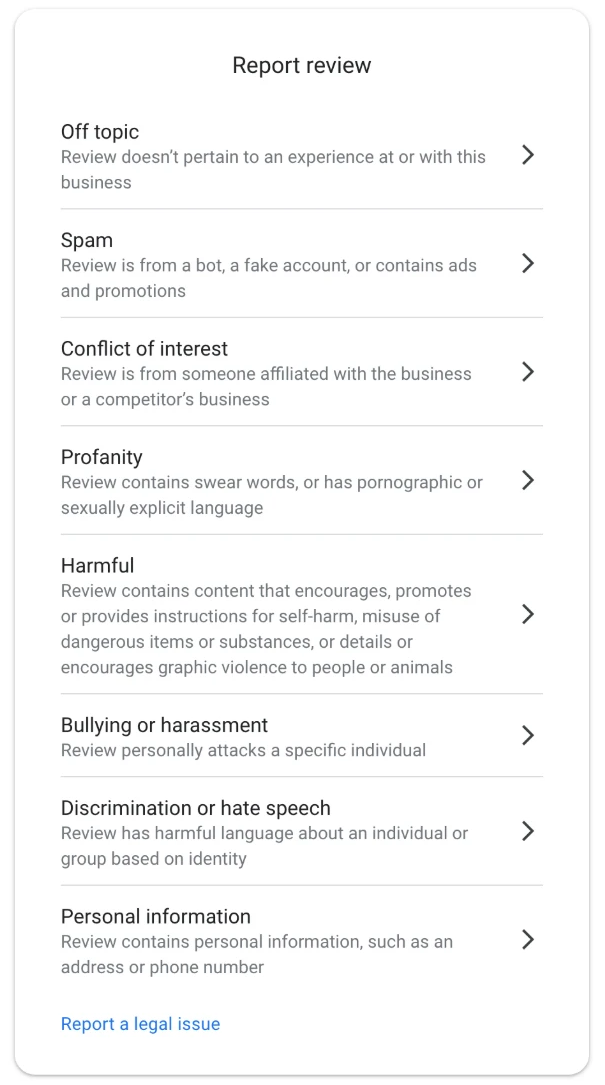
The eight reasons offered in the tool. For a rant with no visit in it, pick Off topic.
There is no text box at this stage, so the reason carries the report on its own. On the public listing and in the Maps app, Off topic is not offered, and Low quality information is the closest match. Use the tool where you can, because it is the only place to check the status and lodge an appeal.
The appeal, if the report is declined
A first report can come back "Report reviewed, no policy violation". That decision opens the appeal, and it is where most of our cases are won. Here is what to do after a "no policy violation" decision.
In the policy field, type Off-topic. In the explanation, quote the commentary exactly, say what it is commentary on, and point out that the review describes no visit, purchase or interaction with your business. Leave your own views on the topic out entirely, however strongly you hold them. An appeal that argues the politics has become a debate, and the reviewer's opinion is not what Google is judging.
This is also the appeal where less is more. You are showing an absence: no visit, nothing about the business, only commentary. The Google Review Removal Playbook has the template for this breach ready to fill in, and it keeps the argument to the point.
If the appeal screen shows "Error accessing the workflow", that is a known fault on Google's side, and this is how to get past it.
How to reply, or whether to
With a rant, the reply is a judgement call. Many owners are better off with a short, neutral line or no reply at all until the decision comes back, because anything longer invites the argument the reviewer came for.
If you reply, keep it to this:
- One line that returns to the business. What you do, and that you are happy to hear about any experience with it.
- A direct contact, in case there really was a visit you do not know about.
- Nothing on the topic itself. No counter-argument, no statement of your own views, no sarcasm.
Something like "We are always glad to hear about a visit, so please get in touch directly if you have been in" is enough. Readers see a business that stays out of the fight.
For a real complaint with a political aside, reply to the complaint and ignore the aside completely. Answer the lukewarm coffee, not the government. Our negative Google review reply templates post explains what each kind of reply is for.
Read the review once more with one question in mind: does it describe anything that happened at your business? If not, report it as Off topic today; if one line does, answer that line and leave the rest alone.
A rant with no visit can come down
Get the Off-topic appeal template that keeps the argument to what matters: no visit, only commentary.
Get the Playbook · $99Several locations or a group? Talk to us about a managed service · Popular locations: Sydney · Melbourne · Brisbane · Perth · Adelaide · Gold Coast · all locations