A Google Review Attacks You for Who You Are: Hate Speech and What Comes Down
2026-09-24
A review on your profile has gone after you, or someone on your team, for who you are. It might be a slur about your ethnicity, a sneer about your accent or religion, or a line like "typical of those people" dropped at the end of a complaint about a late order. You built this business, and now a stranger has put that under your name for every customer to read.
These reviews can come down, and they are among the clearer cases we file. The harder part is telling them apart from a review that looks similar and needs a completely different response.
What the rule covers
Google's Hate speech policy covers content that attacks or demeans people because of who they are: race, ethnicity, religion, nationality, disability, gender, sexuality or age. In a review, that usually shows up as one of three things:
- A slur, however it is spelled or masked with asterisks.
- A generalisation about a group, attached to you or your staff because of their background.
- A statement that someone does not belong, in the country, the industry or the neighbourhood, because of who they are.
Wording that qualifies (invented examples):
- "Typical of that lot, can't run a business properly."
- "Go back to where you came from and take your terrible food with you."
The first turns a complaint into a verdict on a whole group. The second tells the owner they do not belong here. Neither is about the food or the service any more.
Two things surprise owners. First, the reviewer does not have to be fake. A real customer describing a real visit who then attacks the owner's background has broken the rule, and that line is the case, however valid the rest of the complaint might be. Second, the rest of the review does not matter to the report. You are not asking Google to decide whether the order was late. You are pointing at the words that attack a person for who they are.
The lookalike: "I felt discriminated against"
This is the review that gets reported under the wrong reason more than any other in this area.
A reviewer who says they were treated badly because of their background is making an accusation about your conduct. They are not attacking a group; they are saying you did. However wrong you believe that is, it is their account of their experience, and it is not hate speech by them.
Wording that only looks similar:
- "I was the only customer they refused to serve, and I think it was because I wear a hijab."
- "Staff followed me around the shop the whole time. I know why."
Reporting these under Discrimination or hate speech will not work, and it can look like an attempt to silence a complaint about discrimination, which is the last impression you want to leave.
These reviews need a firm, calm reply, and they need it quickly. More on that below.
Other wording that only looks similar
A few more patterns that feel like hate speech but are judged differently:
- Complaints about being understood. "Couldn't understand a word the waiter said" is a complaint about communication. It is unkind, and it is still about the visit. It tips over the line when it moves from the conversation to the person's background: "these people shouldn't be serving customers" is the case.
- Complaints about who a business serves. "Too many kids running around, not a place for a quiet meal" is an opinion about the atmosphere, not an attack on a group.
- Politics with no group attacked. A rant about the government, immigration policy or the state of the world, with nothing about your business in it, is a different breach. See our post on off-topic rants and political reviews.
If the same review also swears at or goes after a named staff member personally, read our post on reviews that attack an employee before you choose. Pick the one breach with the clearest words and file it well; one policy, well made, beats three.
How to report it
- Take a screenshot of the review with the date visible, so you keep the wording if the reviewer edits it.
- Open the Reviews Management Tool, signed in to the account that owns or manages your Business Profile.
- Choose Report a new review, click Report beside the review, and pick Discrimination or hate speech.
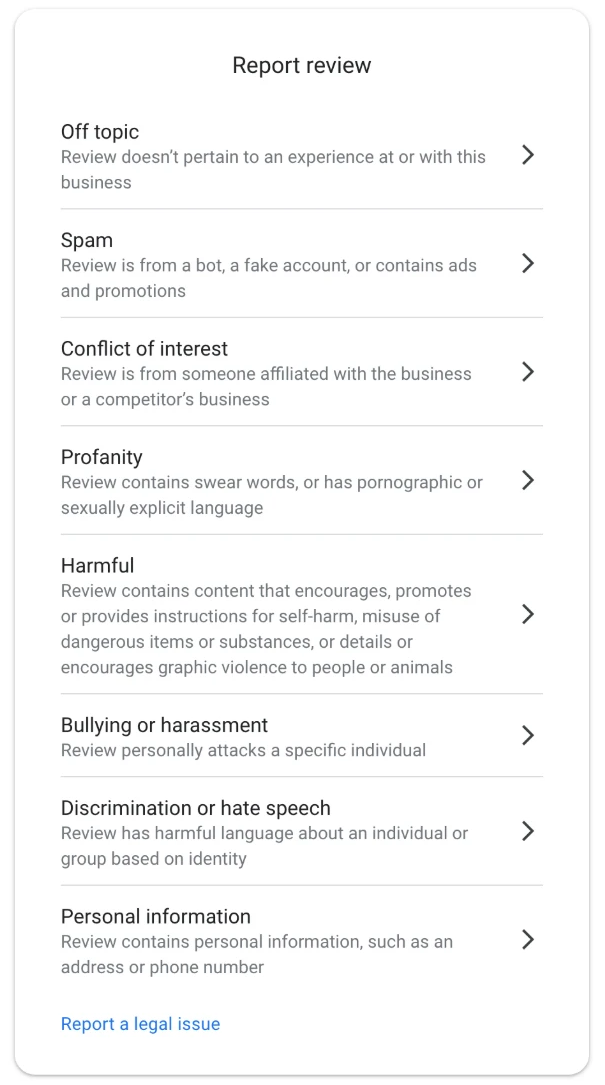
The eight reasons offered in the tool. For a slur or an attack on a group, pick Discrimination or hate speech.
This reason appears on every reporting screen: the tool, your business panel on Search, and the public listing and Maps app. Use the tool if you can, because it is the only place to check the status and lodge an appeal. Our guide to the Reviews Management Tool walks through each screen.
If the review targets a staff member's background by name, that person can also report it from their own Google account. It is their complaint, and it is a separate report from yours. Asking friends or other staff to flag it is a different thing, and it is treated as manipulation.
The appeal, if the first report is declined
A first report can come back "Report reviewed, no policy violation", even on wording that seems obvious. That decision opens the appeal, and it is where most of our cases are won. Our post on how to appeal a Google review decision covers where to find it.
In the policy field, type Hate speech. In the explanation, quote the exact words, say which characteristic they target, and show that they attack a person or a group rather than describe the service. Keep the heat out of it. No capitals, nothing about the reviewer as a person, and nothing about the visit itself. An appeal that argues the order was not late turns a clear breach into a dispute, and Google does not settle disputes.
The connecting sentence, the one that ties the quote to the characteristic and the policy, is what wins these, and The Google Review Removal Playbook has the template for this breach ready to fill in. You get one appeal per review, so it is worth getting right.
Replying, whichever kind of review it is
If it is hate speech, you do not have to reply at all, and there is a case for waiting until the decision comes back. If you do reply, keep it to one or two lines about how you run the business and a direct contact. Never repeat the slur, and never answer the attack on its own terms.
If it is an accusation of discrimination, reply the same day. Future customers read these closely, and silence reads as agreement. A good reply:
- Takes the concern seriously without being defensive.
- States your practice plainly: who you serve, and that you serve everyone the same way.
- Invites the conversation privately, with a name and a direct contact.
Something like "We serve every customer the same way, and I would like to understand what happened, so please contact me directly" carries it. What the reply must not do is argue the details in public, reveal anything about the customer, or suggest they are lying. Our reply templates post explains how the reply for a disputed review is built, and the playbook has the full wording.
Take the accusation seriously in private too. Check with the staff involved, and if something did go wrong, deal with it. A real complaint of discrimination can carry legal consequences, and a careful private response is worth more than a clever public one.
Looking after the person it was aimed at
If the review attacked a staff member's background, talk to them before they find it themselves. Tell them you have reported it, that it says nothing about them, and that you will not be replying in a way that repeats it. Let them decide whether they want to report it from their own account.
If it was aimed at you, the same applies. You do not have to read it again every time you open your profile. Report it, screenshot it for your records, and let the process run.
Read the review once more for the exact words that attack someone for who they are. If they are there, report it as Discrimination or hate speech today; if the reviewer is accusing you of discrimination instead, write the reply before you do anything else.
Hate speech or an accusation? Know which
Get the Hate speech appeal template, and the reply for a discrimination complaint that answers it firmly without making things worse.
Get the Playbook · $99Several locations or a group? Talk to us about a managed service · Popular locations: Sydney · Melbourne · Brisbane · Perth · Adelaide · Gold Coast · all locations