A Google Review Calls Your Trade Business Scammers. The Tradie's Guide to Getting It Down
2026-09-24
A one-star review has gone up calling your business scammers. Maybe it came after a final invoice that was higher than the quote, a deposit for materials that sat in your account while the job waited on a supplier, or a bathroom that took three weeks longer than planned. You know the job was done properly, and you have the texts to prove it. The review does not care.
Some of these reviews come down and some stay up for good. For a trade business the difference usually sits in one or two words, and it is worth finding them before you do anything else.
How a trade job turns into "scammers"
Trade work produces more money disputes than most industries, because the price is often not settled until the job is finished. The reviews we see from trades follow a few patterns:
- The quote and the invoice do not match. You found rot behind the tiles, a second leak, or wiring that was never to standard. You explained it on site, the customer said go ahead, and then the invoice arrived.
- The deposit. You took money up front for materials, then the job was delayed. From the customer's side, they paid and nothing happened.
- The job that ran over. Weather, an inspection, a backordered part. The finish date moved twice.
- The callout fee. You came out, diagnosed the problem, charged for your time, and the customer expected the visit to be free.
- The quote that went nowhere. You measured up and quoted, they thought it was too high, and they want the world to know.
Every one of these can produce an angry review that is still allowed. What matters is whether the reviewer describes what happened to them, or tells readers what you are.
The label versus the account
Google's Misrepresentation policy covers a review that labels your business as criminal, stated flatly as fact: scammers, thieves, fraudsters, crooks, con artists. That is an accusation of a crime presented as settled truth, and it is the case.
An account of the job is not. "Quoted $2,800, charged $3,900, and never explained the difference" is the customer's version of a transaction. However damaging, and however wrong you think it is, Google will not referee it.
Wording that qualifies (invented examples):
- "Took our deposit and disappeared for a month. Thieves."
- "These guys are con artists, do not let them near your house."
Wording that only looks similar:
- "Felt completely ripped off by the final bill." A feeling about their own experience. Allowed.
- "Overpriced cowboys." Rude, but "cowboys" is a dig at the quality of the work and "overpriced" is an opinion about value. Both allowed.
- "Dodgy" or "shonky." A slur on your honesty rather than a flat accusation of a crime. Worth a free report as Bullying or harassment, not an appeal.
Read to the end of long reviews. Customers angry enough to write out a full timeline of a renovation very often finish with a label: four paragraphs about the delayed tiling, then "absolute crooks". The timeline stays. The last line is the case. Our post on reviews that call a business a scam goes further into that line.
The customer who never booked still counts
Many tradies feel that someone who only got a quote should not be able to review them at all. They can. A quote, a site visit, a phone call or an enquiry is an experience with your business, so "they never even booked" is not a breach on its own.
That does not protect the label. A quote shopper who writes "rang for a quote, got a ridiculous number, these people are scammers" has had an experience with you and then stated criminality as fact. The quote makes the review allowed. The word "scammers" is still the breach, and it is reported the same way.
The exception is the reviewer who admits in their own words that they had no contact at all, such as "never used them but my neighbour says they're thieves". That admission opens a second case, covered in our post on reviews from people who were never customers.
Reporting it, and what the appeal leaves out
Take a screenshot of the review before you do anything, so you keep the original wording if the reviewer edits it after seeing your reply. Then open Google's Reviews Management Tool, signed in to the account that owns or manages your Business Profile, click Report beside the review and pick Spam. If you are reporting from the Maps app on site, where Spam is not offered, pick Low quality information.
If the decision comes back "Report reviewed, no policy violation", the tool's status check will show whether the review is eligible for appeal. In the policy field, type Misrepresentation. In the explanation, quote the label exactly as written and show that it states a crime as fact.
Now the part tradies find hardest. Leave your paperwork out of the appeal. The signed quote, the variation texts, the photos of the rot behind the tiles: all of it is true, and all of it turns a question about one word into a dispute about a job, which Google will not settle. Strong appeals quote the reviewer, name the policy, connect the two, and stop. The Google Review Removal Playbook has the template for a crime stated as fact, with a worked example of the wording that connects the quote to the policy.
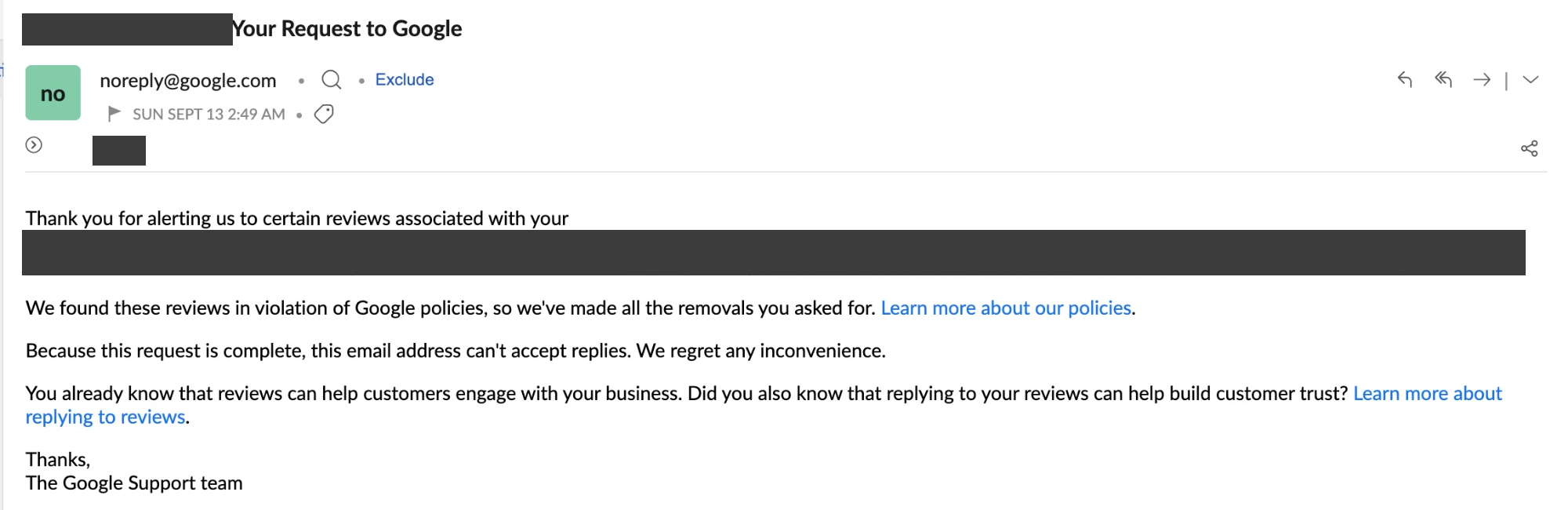
The decision on an appeal we lodged over a review calling a business scammers.
The reply: quotes, variations and one plain sentence
Post a reply the same day you report. If the review comes down, the reply goes with it. If it stays, future customers have already seen how you answer.
For a trade business, the reply does five things:
- Never repeats the word. Writing "we are not scammers" puts "scammers" under your business name a second time. Say what you do instead.
- Acknowledges the specific thing. The final bill was more than they expected, or the job took longer than planned. Name it, so the reply is obviously not a form letter.
- States your practice in one sentence. How you quote and how you handle variations, in plain words. For most trades that is a written quote before work starts and any extra work agreed before it is done.
- Keeps their business private. Not their address, not what they owe, not what was behind their walls. Your reply is public and their house is not.
- Offers to go through the invoice. A name and a phone number, and an invitation to sit down with the paperwork.
A sentence in the right register: "Every job we do is quoted in writing, and any extra work is agreed with the customer before it starts, so I would like to go through this invoice with you." The playbook's reply templates for a price dispute and for an account you dispute cover both versions of this review, and our post on how to respond to a Google review about price goes into the price version in detail.
If the review says they are taking it to Fair Trading or the building commission, answer it the same calm way. A threat to complain to a regulator is not a threat of harm, and a steady reply to it tells every reader you have nothing to hide.
Where your paperwork does belong
Tradies who keep tight records often feel robbed when they learn the appeal cannot use them. The records still earn their keep, just elsewhere.
They belong in the private conversation with the customer, where a variation text sent before the extra work started usually settles the argument. They belong with Fair Trading if it goes that far. And they are what let you write the one-sentence practice statement in your reply with complete confidence, because you know every job really is quoted that way. Our page on Google review removal for trades covers the other patterns we see on trade profiles.
Before you reply to the next money dispute, read the review for the label first: if a crime is stated as fact, report it that day, and if it is only the customer's account of the bill, the reply is where you win it.
Get the scammers label off your profile
The appeal template for a crime stated as fact, plus the price-dispute reply that shows future customers how you quote and handle variations.
Get the Playbook · $99Several locations or a group? Talk to us about a managed service · Popular locations: Sydney · Melbourne · Brisbane · Perth · Adelaide · Gold Coast · all locations