The Same Person Left Two Google Reviews. Which One Comes Down?
2026-09-24
You are reading your one-star reviews and something looks familiar. The same complaint, in almost the same words, about the same missed delivery, posted twice. Perhaps under two different names. Perhaps with the same photo of the same damaged box. One unhappy customer is taking up two places on your profile and pulling your rating down twice.
The good news is that repeated content is against the rules. The less obvious part is that the copy and the original are judged very differently.
How one person ends up with two reviews
A Google account can leave one review per business. If the same account reviews you again, the new review replaces the old one rather than sitting beside it. So when the same person appears twice, it usually means one of these:
- A second Google account. A work account and a personal account, or an old one they had forgotten about.
- A partner's or family member's account, used to post the same complaint again.
- Two of your locations. The same review pasted on your northern and southern branches.
- A second listing of your business. An old or duplicate listing that still collects reviews.
Knowing which one you are looking at decides what you file.
How to spot a duplicate
Put the two reviews side by side, with screenshots, and look for:
- The same wording. Whole sentences repeated, or the same unusual phrase, spelling mistake or sign-off.
- The same photos. The same picture of the same receipt, dish or damaged item.
- The same details. The same date of visit, order number, amount, staff member or sequence of events.
- Dates close together. Two reviews posted minutes or hours apart, often late at night after an argument.
- Thin accounts. A second account with no other reviews, created around the same time, with no profile photo.
One match is a coincidence. Several together is a pattern you can point at.
A lookalike worth knowing: two people describing the same visit. A couple who both review the same dinner, or two colleagues who both sat through the same slow service, have each had their own experience. Their reviews may be similar, and both are allowed. Check that the second review is the same person, not a second person with the same complaint.
Which one comes down
The second copy is the one to report. Repeated content is against the rules, and a second review repeating the first is worth a free report as Spam. Reporting costs nothing and takes two minutes.
The original is judged on its own words. A review does not become removable because it was later copied. If the first review is an account of a real visit with no breach in it, it stays, however angry you are about the second one. Read the original the way you would read any other review: does it contain words that break one of Google's content rules? A label like "scammers", swearing aimed at a person, or an attack on a named employee is the case, not the fact that it was posted twice. Our guide to Google review policy violations covers what to look for.
This matters because owners often report both, pick the same reason for both, and lose on both. Report the copy as repeated content. File the original, if at all, on its own breach.
Multiple accounts: when it becomes Fake Engagement
If one person is using several accounts to leave several reviews, that is more than repetition. Posting from multiple accounts to inflate a complaint is a Fake Engagement matter: the reviews are not separate experiences, they are one person counting themselves more than once.
The catch is proof. Google will not act on "I am sure it is the same person". What carries this is what you can show:
- the same name, or the same first name and surname initial, on both accounts
- the same profile photo
- the same wording or photos, as above
- the reviewer saying so, for example "posting again from my other account since they ignored the first one"
That last one is the strongest, because it is the reviewer's own admission on the page. Without something like it, you are building a pattern, and the stronger the pattern, the better the report.
Two related situations are filed on their own rules. If the second account belongs to a former employee or a competitor, that is a conflict of interest, which needs evidence of who they are: see our post on a review from a competitor. If a wave of reviews arrives from different accounts all at once, see what to do about Google review bombing.
How to report it
- Take screenshots of both reviews, with names and dates visible, before either is edited.
- Open the Reviews Management Tool, signed in to the account that owns or manages your Business Profile. If the copy is on another of your locations, pick that location from the business list.
- Choose Report a new review, click Report beside the second copy, and pick Spam.
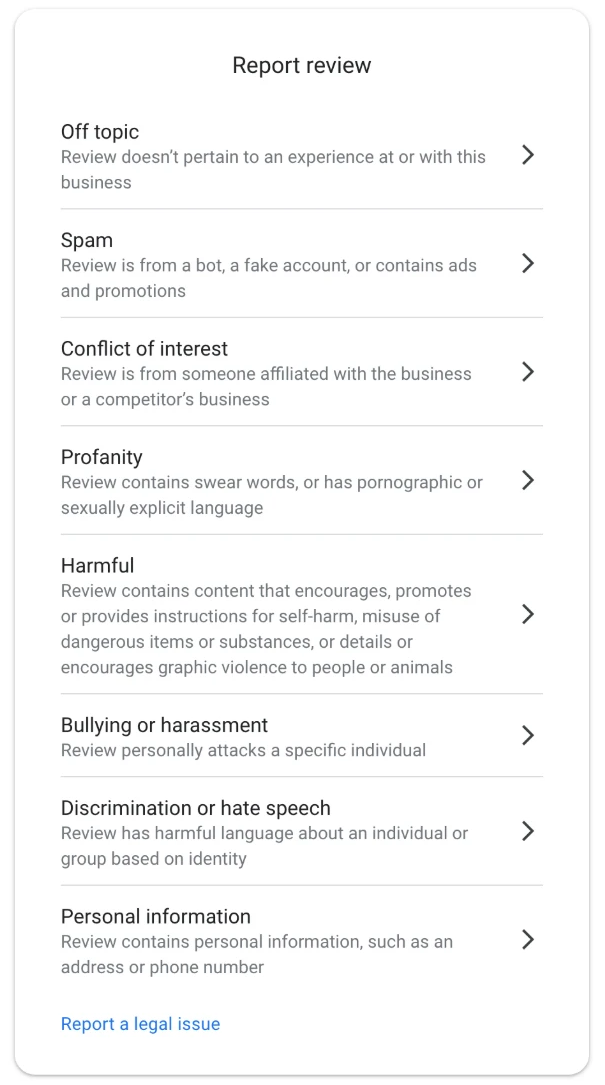
The eight reasons offered in the tool. For a repeated review, pick Spam.
There is no text box at the report stage, so the reason does all the work. From the public listing or the Maps app, where Spam is not offered, Low quality information is the closest match. Our guide to the Reviews Management Tool walks through each screen.
If the copy is on another of your branches, it is also about a different location from the one the customer visited, and that is a separate rule. See our post on a review about the wrong business for how a review of your other branch is handled.
If the copy is on a second listing of your business, the listing is the bigger problem. A duplicate listing splits your reviews and confuses customers, and a Business Profile support case is the place to raise it.
If the report is declined, it becomes eligible for appeal. Repeated reviews are not one of the twelve headline breaches, so there is no numbered appeal template for them, but the same structure applies: one policy, the exact words, and the link between them. The Google Review Removal Playbook covers duplicates in its list of reviews worth a free report, alongside the other cases where two minutes is well spent. Here is what to do after a "no policy violation" decision.
Replying to both
Reply to the original as you would to any complaint: acknowledge it, state your practice plainly, give a direct contact. That reply does the real work, because it is the one that stays if nothing comes down.
For the copy, keep the reply to one neutral line that points back to your first answer. Something like "We have replied to this above and would still like to resolve it directly" tells readers you have not ignored it, without accusing anyone of posting twice.
What the reply must not do is say "this is the same person" or "fake account". If you are right, the report will deal with it. If you are wrong, you have accused a second real customer in public. Our post on how to reply to a fake Google review covers the tone.
Before you report either review, put the two side by side and list what matches. The copy is the free report; the original only comes down on its own words, so read it again for a breach before you assume it is safe.
One customer, two reviews. Report the copy
The playbook's free-report list covers duplicates, and its twelve breach checks tell you whether the original can come down too.
Get the Playbook · $99Several locations or a group? Talk to us about a managed service · Popular locations: Sydney · Melbourne · Brisbane · Perth · Adelaide · Gold Coast · all locations