The Review Is About a Different Business. How to Get It Off Your Profile.
2026-09-24
The one-star review on your plumbing business complains about a cold pizza. Or it describes a haircut when you are a nail salon, names a street you have never traded on, or praises a rival's staff by name before tearing into "this place". Someone has clearly reviewed the wrong business, and the rating is now sitting on yours.
These are some of the easier reviews to deal with, because the evidence is usually on the page. The one trap is a review that looks misplaced but is still about you.
Why it happens
Wrong-business reviews are rarely malicious. We see the same handful of causes over and over:
- Similar names. Two cafes with a shared word in the name, two firms with the same surname.
- Shared addresses. A shopping centre, an arcade, a medical suite or an office building where several businesses sit side by side on the map.
- The previous tenant. A customer who remembers the old business at your address and reviews what they think is still there.
- Search results. Someone searches a service, taps the first listing, and reviews it from memory without checking the name.
Knowing the cause helps with the reply later, because most of these reviewers would move the review themselves if they realised.
What the rule covers
Google's Off-topic policy covers reviews that are not about the business they are posted on. A review that clearly describes another company, another location or a product you do not sell has nothing to do with your business, and it should not count against your rating.
Wording that qualifies (invented examples):
- "Ordered a large supreme at 7pm and it arrived cold." Posted on a locksmith.
- "Went to the one on the main road opposite the station." You are nowhere near a station.
- "The massage was lovely, but the change rooms need work." You sell car parts.
The test is whether a stranger reading the review next to your profile would see at a glance that it cannot be about you. Products you do not sell, a service you do not offer, an address that is not yours, or a business name that is not yours are all things you can point at.
Wording that only looks similar
Some reviews feel misplaced but are still about your business, and they are judged differently.
A review of your other branch. If you have two locations and a customer reviews the northern store on the southern store's listing, it is still your business. It is worth a free report as Off topic, and it needs a reply pointing to the right location. It is not the same clear case as a review of a different company.
A service you do sell, from someone you cannot place. "The quote was far too high and nobody called back" describes something you do, even if you have no record of the call. That is not a wrong-business case. It is closer to a reviewer you do not recognise, which is covered in our post on reviews from someone who was never a customer.
The business before you bought it. If you bought a business and kept its listing, a review about the previous owner's time is still about that business. It feels unfair, but it is a reply, not a report.
A mistake about a detail. A review that gets your opening hours wrong or thinks you are on the wrong corner is still describing a visit to you.
If in doubt, read the review for anything that actually happened at your business. If there is a real visit in it anywhere, look for a different breach or reply to it.
How to report it
- Take a screenshot of the review with the date visible. It helps to capture the detail that proves it is not about you, such as the product or the address.
- Open the Reviews Management Tool, signed in to the account that owns or manages your Business Profile. If you have several locations, each is listed separately, so pick the one the review is posted on.
- Choose Report a new review, click Report beside the review, and pick Off topic.
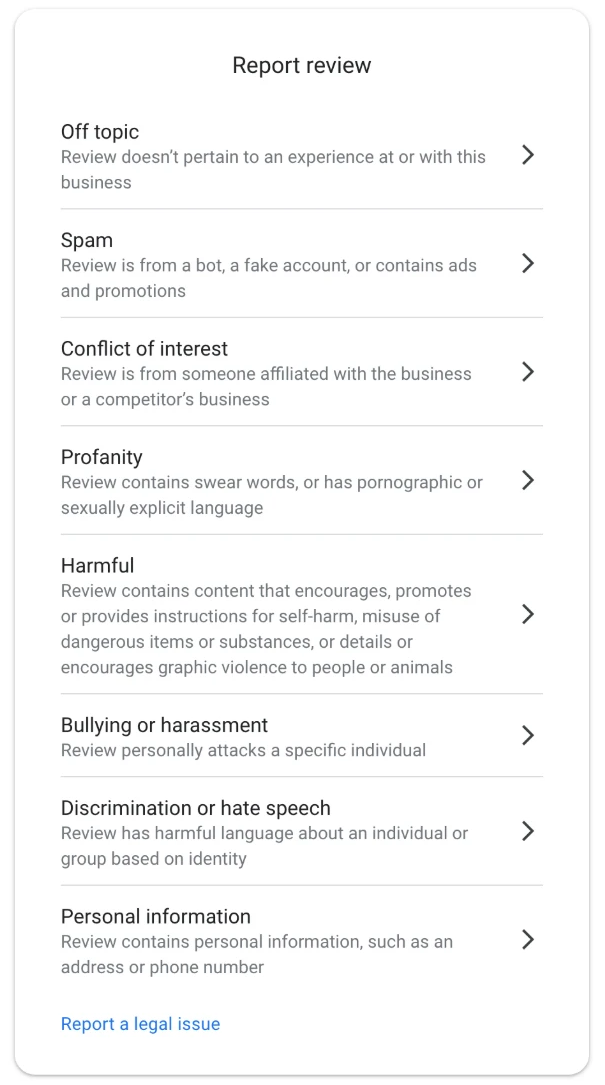
The eight reasons offered in the tool. For a review of another business, pick Off topic.
There is no text box at the report stage, so the reason does all the work. If you report from the public listing or the Google Maps app instead, Off topic is not offered; Low quality information is the closest match on that shorter list. The tool is the better door, because it is the only place to check the status later and lodge an appeal. Our guide to reporting a Google review as a business owner walks through both routes.
The appeal, if the report is declined
A first report can come back "Report reviewed, no policy violation", even when the review is plainly about a pizza shop. That opens the appeal. Here is what to do after a "no policy violation" decision.
In the policy field, type Off-topic. In the explanation, quote the words that show the review is about something else, state plainly what your business is, and connect the two. Leave out your ratings, your other reviews and how unfair it is.
This is one of the few breaches where a fact about your business belongs in the appeal, because the case rests on the gap between the review and what you sell. Keep that fact to one line, and let the quote carry the rest. The Google Review Removal Playbook has the template for this breach, with the slots marked for what you sell and what the review is really about.
You get one appeal per review. If the appeal screen shows "Error accessing the workflow", that is a known fault on Google's side, and this is how to get past it.
Reply the same day
Whatever you file, post a reply. A wrong-business review has an unusual advantage: the reviewer usually has no quarrel with you, and a polite note often gets it moved by the person who wrote it.
A good reply here:
- Stays friendly. They made a mistake, and a friendly correction reads well to everyone else.
- Says what you are in one line: what you sell and where you are.
- Suggests it may be meant for another business, without naming a rival or sending customers to them.
- Gives a direct contact in case you have got it wrong.
Something like "We are a locksmith, so we think this may be meant for another business nearby, but please get in touch if we have missed something" does the job. It shows every reader the review is not about you, and it gives the reviewer an easy way out.
For a review of your other branch, name the right location in the reply and invite them to contact that store. You keep the customer, and anyone reading sees a business that knows its own locations.
What the reply must not do is mock the mistake. Readers see the tone before they see the facts, and a sarcastic reply to an honest error costs more than the review. Our negative Google review reply templates post explains what each kind of reply is for.
If it keeps happening
If you get more than one misplaced review, look at why. Check that your profile's name, category, photos and address pin match your shopfront, and that customers can tell you apart from the business next door. A clear shopfront photo and an accurate category solve more wrong-business reviews than any report does.
If the review is on a second listing of your business that you did not create, the listing is the problem, not the review, and a Business Profile support case is the place to raise it.
Read the review once more and find the detail that proves it cannot be about you: a product you do not sell, an address you have never traded from, a name that is not yours. That detail is your report, and it is also the first line of your reply.
Get someone else's review off your profile
The playbook's Off-topic appeal template shows exactly what to say about your business and the review, and where to stop.
Get the Playbook · $99Several locations or a group? Talk to us about a managed service · Popular locations: Sydney · Melbourne · Brisbane · Perth · Adelaide · Gold Coast · all locations