Gym Reviews About Cancelled Memberships: What Comes Down and How to Reply
2026-09-24
A member says they cancelled, the direct debit came out again anyway, and now there is a one-star review at the top of your profile that ends with the word "thieves". You have their cancellation form, the notice period they signed up to and a billing history that explains every payment. None of it will get the review removed.
Something else in it might. Gym reviews about cancellations follow a pattern we see over and over, and the part Google acts on is rarely the part that makes owners angriest.
Why cancellation reviews land on gym profiles
A gym membership is a billing relationship that runs in the background. Most members never think about it until a payment appears on a bank statement after they believed they had left. That is usually the moment the review gets written, often weeks after their last session and with no mention of the training at all.
The same situations come up again and again:
- The debit after cancelling. The member cancelled, but inside a notice period, so one or two more payments came out.
- The minimum term. They joined on a contract and want out early, and the exit fee feels like a penalty.
- The wrong channel. They emailed a trainer or told the front desk in passing, while your terms ask for a form or the app.
- The freeze that did not apply. A suspension for travel or injury was requested but never processed, or ran out.
- The billing company. Payments are collected by a third party, and the member cannot get anyone to stop them.
- The overdue account. Missed payments went to collections and the member is furious about the letters.
Every one of these is a first-hand account of a real experience with your business. However one-sided, however much it leaves out, the story stays up. Google will not read your terms and decide who is right about a notice period, and a report built on "we followed our contract" asks it to do exactly that.
The account stays. The label is the breach.
What Google does act on is a label: the reviewer stops describing what happened and tells the world your business is criminal, stated flatly as a fact. That falls under Misrepresentation.
Wording that qualifies (invented examples):
- "Absolute thieves. Do not give them your bank details."
- "This gym is a scam that steals from its members."
Wording that only looks similar:
- "They kept taking money for two months after I cancelled." An account of events.
- "Impossible to cancel, the worst experience I've had with any business." An opinion about the experience.
- "Daylight robbery for what you get." An expression about price, and opinions about value are always allowed.
- "It felt like a scam." A feeling, framed as theirs.
There is a middle ground gyms see a lot: "They stole two payments from me after I cancelled." The crime word is there, but it is attached to a specific debit the reviewer is describing. That reads closer to an account told in strong language, so it is worth a free report, but it is weaker ground for your one appeal than a flat "thieves" or "scammers".
Read long reviews to the very last line. A member who writes three paragraphs about notice periods and billing companies very often signs off with "Scammers. Avoid." The three paragraphs stay. The sign-off is the case. Our post on reviews calling your business a scam covers the label versus account distinction across every industry, with an appeal we won on exactly this wording.
Reporting the label, and what the appeal leaves out
Take a screenshot of the review before you do anything, so you keep the wording if the member edits it. Then open Google's Reviews Management Tool while signed in to the account that manages your profile, choose "Report a new review", click Report beside the review and pick Spam. On this screen there is no reason named Misrepresentation and no text box, so Spam carries this breach.
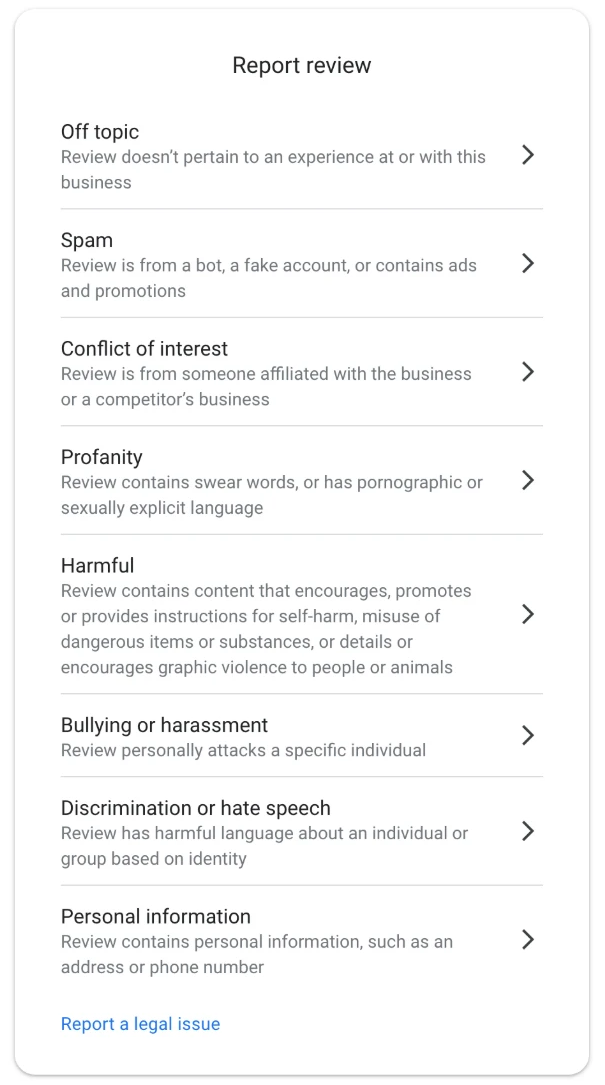
The tool offers eight reasons. For a label like "thieves", pick Spam.
If you report from the public listing or the Maps app instead, Spam is not on the list, and Low quality information is the nearest match.
A first report often comes back "Report reviewed, no policy violation", which is the step that makes the review eligible for an appeal. In the appeal, the policy field takes Misrepresentation. The explanation quotes the label word for word, names the policy and connects the two. What it leaves out matters just as much for a gym: no membership agreement, no notice period, no payment dates, no mention of the billing company. The moment the appeal argues that the debits were correct, it becomes a dispute about the contract, and Google does not settle those. The Google Review Removal Playbook has the appeal template for this breach, with a worked example on a "scammers" review.
When the member offers to delete it for a refund
Some cancellation reviews come with a price attached: "Refund the last two debits and I'll take this down." A demand for money in exchange for removing or changing a review is a breach of its own. It falls under Fake Engagement, because the review is being used as a bargaining chip rather than as an account of an experience. Report it as Spam, and in an appeal quote the demand exactly as written. Our post on a reviewer demanding a refund to remove a review goes through the variations.
Two things to keep straight:
- The demand has to come from them. A member who writes "they offered to waive my exit fee if I deleted this" is describing your behaviour, not making a demand, and that review has no case under this breach.
- Never make that offer yourself. Waiving a fee or refunding debits on the condition that a review comes down is offering something in return for a review, which breaks Google's rules and hands the member a screenshot for the next version of their review.
If the member is owed money, refund it because they are owed it, and leave the review out of the conversation entirely. Some members update a review on their own once the problem is fixed. Asking them to is where it goes wrong.
Gym cancellation reviews can cross one more line. When the member names someone on your front desk and turns on them as a person ("[Name] on reception is a liar and should be sacked"), that is a Harassment case separate from the billing story. Naming staff is allowed; the attack on the named person is the breach. Our post on reviews attacking an employee explains where that line sits.
The reply: one plain sentence on how cancelling works
Most cancellation reviews will stay, so the reply under them is the part you control. It is written for the next person comparing gyms, who wants to know one thing: if I join and later want to leave, will this place make it hard?
A reply that answers that question does four things:
- Acknowledges the frustration without conceding the facts.
- States your cancellation practice in one plain sentence, so the next reader knows exactly how it works.
- Moves the rest offline to a named person with a direct email or number, such as the club manager.
- Leaves the word they used alone. "We are not thieves" puts "thieves" under your name a second time.
The single sentence is where most of the work gets done, and it should be something anyone can check, for example: "Memberships can be cancelled at any time through the app or at reception, with [your notice period] notice." Readers can hold you to that, which is exactly why it reassures them.
What the reply must not contain is the member's account. No cancellation date, no payment history, no number of missed debits, no mention of collections, and no check-in records. "Our system shows you only visited twice" might feel like a winning point, but it publishes a member's attendance to the whole internet and reads as petty to everyone else. The Google Review Removal Playbook has a reply template for a refund or policy dispute that is built for this situation and keeps every private detail out.
One piece of pushback, because it is the part that moves your rating most. If several reviews describe the same trouble cancelling, the problem may be the process rather than the members. A gym that accepts cancellation by email, confirms it in writing the same day and sends a final billing date takes the fuel out of most of these reviews before they are written. The gym review removal page covers the other patterns we see on fitness profiles.
Before you report or reply
Put the contract aside and read the review the way a stranger would.
- Is there a flat label: scammers, thieves, fraud, crooks? If yes, screenshot it and report it as Spam today.
- Does the member offer to remove or change the review in exchange for a refund? If yes, report it as Spam and keep the exact wording.
- Does it turn on a named staff member as a person? That is a separate Harassment case.
- None of the above? It is an account, and it stays. Put your time into the reply.
Whichever it is, post the reply the same day you report, and make its one sentence about cancelling true on your busiest Monday, not just on paper.
Stop cancellation reviews costing you new members
Get the appeal template for thieves and scammers labels, plus the reply that explains how cancelling works without discussing anyone's account.
Get the Playbook · $99Several locations or a group? Talk to us about a managed service · Popular locations: Sydney · Melbourne · Brisbane · Perth · Adelaide · Gold Coast · all locations