A Reviewer Says They Will Take It Down If You Pay. That Is a Breach.
2026-09-24
A one-star review has gone up, and then the message arrives: refund me and I will take it down. Sometimes the demand is written into the review itself, sitting there for every customer to read. Sometimes it comes by email, text or a social media message a day later. Either way, someone is using your rating as a bargaining chip.
This is one of the situations where the reviewer hands you the evidence. Handled properly, the demand is the case.
What the rule covers
Reviews are meant to describe an experience. Google's Fake Engagement policy covers reviews that are used for something else, and a review held hostage for a refund, a replacement or a payment has stopped being an account of a visit. It has become a tool for getting something out of you.
The case exists when the reviewer states, in writing, that they will remove or improve the review if you pay, refund or give them something. Two parts matter:
- The demand comes from them. Not from you, and not implied. They have tied the review to an outcome in their own words.
- It is in writing. In the review, in an edit to the review, or in a message you can screenshot.
Wording that qualifies (invented examples):
- "Refund the full amount and this review disappears. Your call."
- "Send a replacement by Friday and I'll change it to five stars."
In both, the review is openly on offer. That is what makes it a breach, whatever happened with the original order.
The reviewer does not have to be fake. Most of the demand cases we see come from real customers with a real complaint who then made the review conditional on getting their way. The complaint may even have merit. The condition is still the breach.
Wording that only looks similar
A reviewer saying you offered a refund to delete the review. "They offered me my money back if I took this down." That is the reviewer describing your behaviour, not making a demand, so this breach does not apply. It is also exactly why you should never make that offer: it gives them something far worse to write about. It needs a careful reply, covered below.
A reviewer saying they will update once it is fixed. "Will update if they sort this out." That is a normal intention from someone waiting on a resolution. It does not name a payment or tie the review to one, so it is not the case. If you fix the problem, it is fine to let them know and to say you would be grateful if they updated the review.
A threat made before the review. "Refund me or I'm leaving you one star" arrives before anything is posted. That is a different situation with different options, covered in our post on a customer threatening a bad Google review. Keep the message. If they post the review and then offer to remove it for money, you are back in this post.
A demand to a regulator or a lawyer. "Refund me or I'm going to Fair Trading" is a threat of a complaint, not a review for sale. See our post on swearing and threats in a Google review for how those are treated.
Keep the message, and never pay
This is the part owners most often get wrong under pressure.
Keep everything. Screenshot the review with the date visible. Screenshot every message where the demand appears, with the sender, the date and the words readable. If the demand is in an edit to the review, screenshot both versions as soon as you see them. Reviewers who realise what they have written sometimes delete it.
Never pay to remove a review. Paying does not buy safety. Nothing stops them posting again, and you have paid for a review you still do not control. It also teaches the reviewer, and anyone they tell, that your business pays out.
Never offer money for a review change. Offering a refund, a discount or a freebie in exchange for editing or removing a review breaks Google's rules on your side, and it puts your own profile at risk. It is also the one thing that turns a clean case into a messy one.
There is an honest version of this that is fine. If the complaint has merit, fix it: refund, redo or replace because it is the right thing to do. Once they are satisfied, you can say you would be grateful if they updated their review to reflect how it ended. What you cannot do is make the fix conditional on the review.
How to report it
- Open the Reviews Management Tool, signed in to the account that owns or manages your Business Profile. Our guide to the Reviews Management Tool walks through each screen.
- Choose Report a new review, click Report beside the review, and pick Spam.
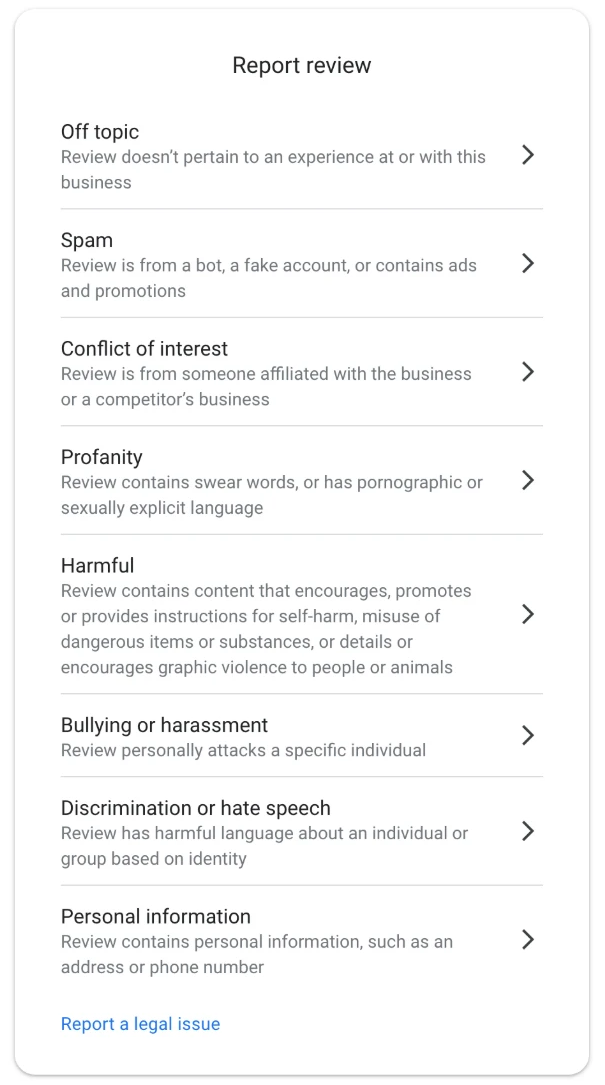
The eight reasons offered in the tool. For a review offered in exchange for a refund, pick Spam.
There is no text box at the report stage and no place for your screenshots yet, so the reason does all the work. From the public listing or the Maps app, where Spam is not offered, Low quality information is the closest match. The tool is the better door, because it is the only place you can check the status and lodge an appeal later.
Google also runs a separate form for owners facing review extortion, where you can describe the demand and attach the messages. Searching for Google's review extortion report will find it. Use it alongside the report, not instead of it.
The appeal, and where your screenshots go
If the report comes back "Report reviewed, no policy violation", the review becomes eligible for appeal. Here is what to do after a "no policy violation" decision.
This is one of the few appeals where attachments do real work. For most breaches the review's own words are the evidence. For a demand that arrived by message, the screenshot is the evidence, so attach it.
In the policy field, type Fake Engagement. In the explanation, quote the demand word for word, and show that the reviewer has made removal or improvement conditional on receiving something. Leave out whether the refund was deserved, what went wrong with the order, and your other reviews. The moment the appeal argues about the original complaint, it becomes a dispute about facts, and Google does not settle disputes.
The sentence that connects the demand to the policy is what wins these, and The Google Review Removal Playbook has the template for this breach, with a worked example built on a refund-and-replace demand. You get one appeal per review, so build it once, properly.
How to reply while it is being decided
A calm public reply works in your favour here, because the reviewer has made the conversation about money rather than the service.
A good reply:
- Acknowledges the complaint in a sentence, without arguing the details.
- States your normal practice for refunds or returns, plainly.
- Gives a direct contact to resolve the problem itself.
- Says nothing about the demand, the report or any messages.
Something like "Refunds are handled under our returns policy, and I would like to resolve the problem itself, so please contact me directly" carries it. Readers see an owner who deals with problems on the merits.
If the reviewer claims you offered them money to delete the review and you did not, the reply matters even more. State your practice in one line, do not call them a liar, and invite them to get in touch. Our negative Google review reply templates post explains the reply built for a refund or policy dispute, and the playbook has the full wording.
In serious cases, where someone demands money with menaces, it may also be a matter for police. Your screenshots are what make that report credible.
Before you answer the message, screenshot it. The words they wrote to get money out of you are the strongest thing you have, and they only help you if you still have them when the report is declined.
They put a price on the review. Use it
The playbook's demand template comes with a worked example, and shows what evidence to attach so the demand works against them.
Get the Playbook · $99Several locations or a group? Talk to us about a managed service · Popular locations: Sydney · Melbourne · Brisbane · Perth · Adelaide · Gold Coast · all locations