Google's Fake Engagement Policy: What It Covers Beyond 'Fake Reviews'
2026-09-24
You are sure a review is fake, and you have heard Google has a policy for fake reviews. It does, and it covers far more than bots and review farms. It also covers far less than most owners hope, because it turns on what you can show, not on what you suspect.
The policy is broader than its name suggests, and stricter about evidence than most owners expect. Both matter before you report anything under it.
What the Fake Engagement policy is for
A rating is only useful if every review behind it is one person's real experience, given freely. Fake Engagement protects that. It covers anything that makes a rating say something other than what real customers experienced.
That is a wider idea than "fake reviews". A review can be written by a real person, under their real name, and still break this policy, because the problem is not who wrote it but why and on what basis. A rival writing about you, a customer paid to write about you and a reviewer using the review as a bargaining chip are all real people. None of them is giving a free account of a real experience.
It also cuts both ways. The same policy that can take down a rival's one-star can take down five-stars a business bought, swapped or asked its staff to write. It applies to your profile as much as anyone's.
What its wording bans
In plain English, the policy bans content that does not reflect a real experience of the place, and content posted to manipulate a rating. In practice, that covers:
- Reviews from people with no experience of the business. Someone reviewing what they heard or read about you, not something that happened to them.
- Conflicts of interest. Reviews from a competitor, a current or former employee, the owner reviewing their own business, or anyone with a personal stake in the rating.
- Paid or incentivised reviews. Reviews written in exchange for money, a discount, a free product, an entry in a prize draw or any other reward, whether the review is positive or negative.
- Review swaps. Two businesses agreeing to review each other, or a group trading reviews among its members.
- Reviews used as a bargaining chip. A reviewer who says they will remove or improve the review if they get a refund, payment or something else.
- One person, many voices. Posting from several accounts to multiply one opinion.
- Selective asking. A business asking only its happy customers for reviews, or discouraging unhappy ones from posting.
Paid reviews, swaps and selective asking are the items to check against your own habits before anyone else's. Asking every customer for a review is fine. Offering a coffee voucher for one, swapping with the café next door or asking staff to "help the numbers" is not, and reviews that break the policy can be removed from your profile, taking your rating with them.
What it does not cover
This is where most owners lose time. Each of these feels like a fake review, and on its own, none of them is a case.
- A review you are sure is fake, with no proof. Suspicion, however strong, is not evidence. Google does not act on a hunch about who wrote something.
- No match in your records. People review under nicknames, partners' accounts and old email addresses. Google does not check your booking system, so a report built on it asks Google to take your word over theirs. Our post on a review from someone who was never a customer explains what does count.
- A new account, no photo, one review. Plenty of real customers review once in their life, for the business that annoyed them.
- Quotes, enquiries and phone calls. A reviewer who rang for a price has had an experience with your business, and can review it.
- A star-only rating with no text. There are no words to point at. Our post on one-star reviews with no comment covers what to do instead.
- A reviewer saying you offered a refund to remove the review. That is them describing your conduct, not making a demand of their own.
- A cluster of one-stars in a week. Worth looking at closely, but each review still stands or falls on its own evidence. Our post on Google review bombing covers the pattern.
For a review you believe is fake but cannot prove, the public reply does the work. How to reply to a fake Google review shows how to make the point without an accusation you would need to back up.
The breaches filed under Fake Engagement
Three of the 12 breaches we file for clients sit under this policy, and two more situations belong with them. Each of the three has its own post, so here is only where each one sits.
The reviewer says they never used you. The admission has to be in the reviewer's own words, on the page: "never been a customer", "haven't been in and never will". The detail is in they were never a customer: can you get the review removed.
A conflict of interest you can prove. A rival or a former employee reviewing you as if they were a customer, with evidence that links the account to the person. The evidence is the whole case. Getting a competitor's Google review removed covers what proof looks like, and a fake review from an ex-employee covers the staff version.
A demand in exchange for changing the review. The reviewer offers to take the review down or improve it if you pay, refund or replace something. The demand has to come from them. When a reviewer demands a refund to remove their review walks through it. Google also runs a separate form for review extortion, worth using alongside the report.
Paid, incentivised and swapped reviews. These are rarely admitted on the page, so they come down to evidence: a message offering payment, a reviewer who mentions the voucher they were given, a ring of businesses all reviewing each other. Report them with whatever you can show, and treat them as a free report unless the evidence is clear.
One person posting more than once. The same complaint from the same person, or from a second account, is worth a free report. Our post on duplicate Google reviews from the same person covers it.
Which report reason to pick, on each screen
There is no reason called Fake Engagement on any reporting screen, so the reason you pick depends on what the review does. The Reviews Management Tool and the business panel on Google Search both offer Spam and Conflict of interest. The public listing and the Maps app offer neither.
| The review | Tool or business panel | Public listing or Maps app |
|---|---|---|
| Reviewer admits they never used you | Spam | Low quality information |
| A rival or ex-employee, with proof | Conflict of interest | Low quality information |
| A demand to change the review | Spam | Low quality information |
| Paid, swapped or multi-account reviews | Spam (Conflict of interest if you can show a rival is behind it) | Low quality information |
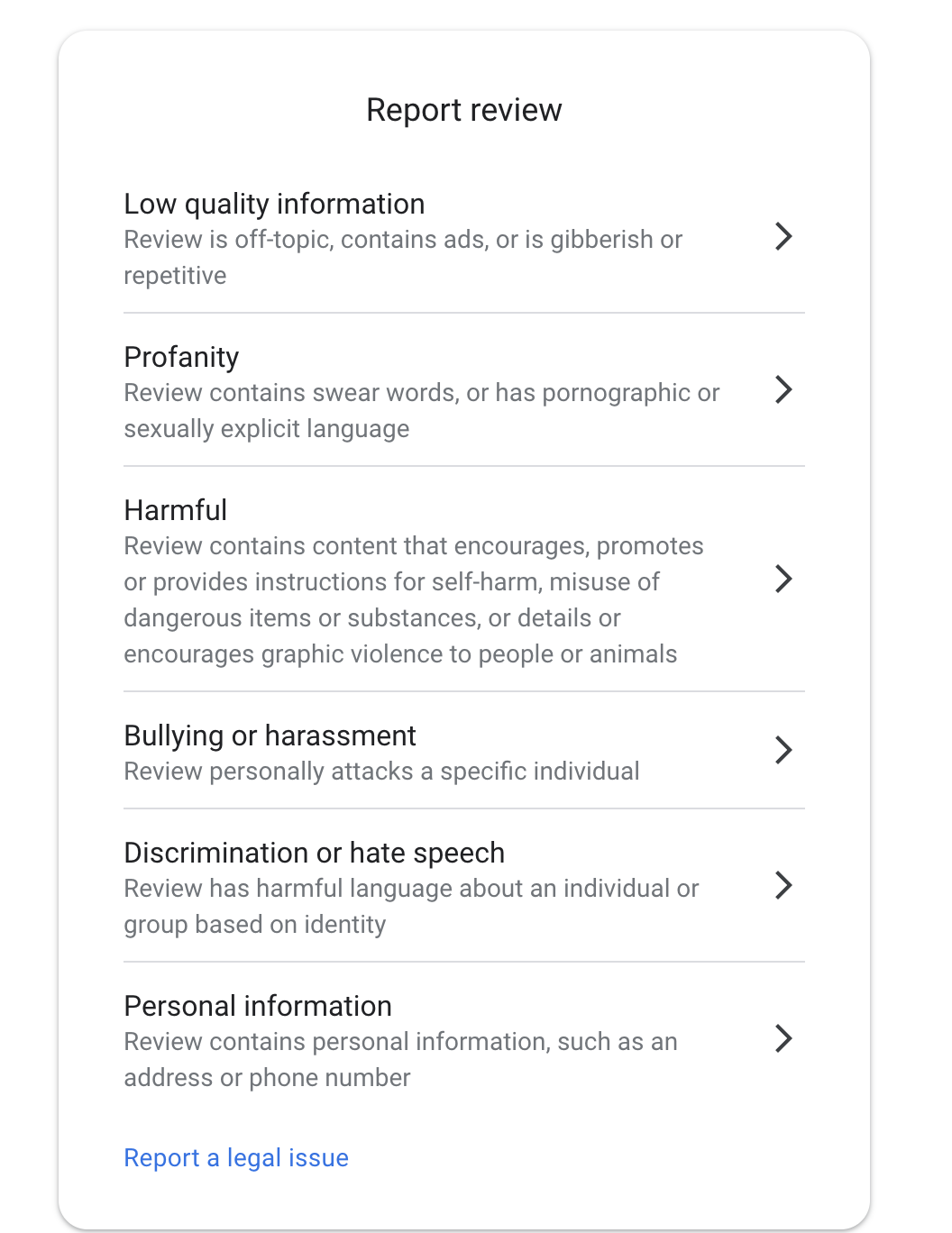
The public listing and Maps app fold Spam, Off topic and Conflict of interest into Low quality information. Use the owner routes where you can.
Low quality information still gets the review into the system, but it tells Google less about what you are pointing at. Report from the Reviews Management Tool, signed in to the account that manages your profile, whenever you can. Our guide to the Reviews Management Tool shows each screen.
If the report comes back "no policy violation", you get one appeal per review, and the policy to type is Fake Engagement for all three breaches. The appeal is built on the reviewer's own words for an admission or a demand, and on the attached evidence for a conflict of interest. Those three appeal templates, with worked examples, are in The Google Review Removal Playbook.
Before you file anything under this policy, finish one sentence: "I can show this review is not a free account of a real experience because..." If the end of that sentence is a quote or a screenshot, report it today; if it is "I just know", write the reply instead.
Turn suspicion into a case Google hears
Three Fake Engagement appeal templates (admission, rival, demand), what evidence to attach, and the reply for the fake review you cannot prove.
Get the Playbook · $99Several locations or a group? Talk to us about a managed service · Popular locations: Sydney · Melbourne · Brisbane · Perth · Adelaide · Gold Coast · all locations