Google's Obscenity and Profanity Policy: Which Swearing Gets a Review Removed
2026-09-24
A review on your profile swears. Maybe once, in passing. Maybe a string of asterisks aimed squarely at the person who served them. Owners tend to assume any swearing breaks Google's rules. It does not, and the policy that covers it, Obscenity & profanity, draws its line somewhere more specific than "bad language".
The policy cares less about which word was used than about where it was pointed. That one idea sorts almost every review with swearing in it.
What the Obscenity & profanity policy is for
Reviews are read by everyone: families choosing a restaurant, patients choosing a dentist, people scrolling on the train. The Obscenity & profanity policy keeps them usable for that audience, and it stops language being used as a weapon, to insult someone or to hammer a complaint home.
It is not a clean-language filter. A review is allowed to be blunt, and an adult writing about a bad experience will sometimes use an adult word. The policy is aimed at swearing that does a job: insulting a person, insulting the business, or turning criticism into abuse.
What its wording bans
In plain English, the policy bans obscene, profane or offensive language used to offend or to emphasise criticism. In reviews, that covers:
- Swearing aimed at a person. Profanity directed at a staff member, the owner or anyone else: "the useless sh*t on the front desk".
- Swearing aimed at the business. "What an absolute f***ing joke of a business." The target is you, and the word is there to insult.
- Profanity used to drive the complaint home. Swearing stacked through a review to turn a complaint into abuse, rather than one word in passing.
- Obscene or crude content. Vulgar remarks and gestures described in words, including crude sexual comments.
The word to hold on to is target. Swearing that points at someone or at your business is the case. Swearing that points at nothing in particular rarely is.
Repetition counts for something too. One word in passing is a weak case. The same word three times across a short review, each time aimed at the business or the person who served them, is not in passing any more; it is the reviewer using profanity to make the point, which is exactly what the policy describes.
Masked words still count. "Sh*t" and "f***ing" are the same words to every reader, and asterisks do not take a review outside the policy when the word is aimed at someone. When you report or appeal, quote it exactly as written, asterisks and all.
A close neighbour of this policy is Sexually explicit content, a separate rule covering graphic sexual descriptions and content written to be sexually gratifying. It matters here because of how it is reported, covered below.
What stays: swearing without a target
Each of these contains a word some owners would rather not see, and each one stays.
- A mild word once, about a thing. "The food was crap." One soft word, used once, about a plate of food.
- Swearing about the reviewer's own state. "A bloody long wait." "I was fed up to the back teeth." The reviewer is describing how they felt, not insulting anyone.
- Rude without being profane. "Useless", "clueless" and "a joke" are not swear words. If they are aimed at a named person, the question moves to Harassment; if not, it is a strong opinion.
- Unflattering, not explicit. "The receptionist was flirting instead of working" is unkind, but it is not sexual content. If it names and demeans her, that is a Harassment question.
- A reviewer reporting what was said to them. "The tradie swore at me when I questioned the bill" is an account of your staff's conduct, not profanity aimed by the reviewer. The reply matters far more than a report here.
A mild word in passing, on a review that is otherwise a calm account, is worth a free report at most. Do not spend your one appeal on it.
The breaches filed under this policy, and the one beside it
Two of the 12 breaches we file for clients are reported under this policy's button, though only one is appealed under its name. Each has its own post, so here is only where each one sits.
Swearing aimed at a person. Profanity used to insult someone or your business. Reported as Profanity and appealed under Obscenity & profanity. The wording that qualifies, and how threats sit alongside it, is in swearing and threats in a Google review.
Sexual content. A graphic sexual description, whoever it is about. This files under Sexually explicit content, but there is no separate report reason for it on any screen, so it is reported as Profanity and appealed under its own policy name. Removing a Google review with sexual content covers the detail.
Then the tie-break that matters most. When the swearing is aimed at a named employee and the review attacks them personally, file it under Harassment, not here. The Harassment policy covers everything the review does to that person; this policy covers only the word. Swearing at a named employee combined with a personal attack on them is the strongest everyday case there is, and reviews that attack a staff member by name explains it, with a manager's case we won on appeal. The same goes for a crude sexual remark aimed at a named staff member: Harassment is usually the stronger policy. Our explainer on Google's harassment policy covers the wider picture.
Which report reason to pick, on each screen
Profanity appears on all three reporting screens: the Reviews Management Tool, the business panel on Google Search, and the public listing or Maps app. Pick it for swearing with a target and for sexual content.
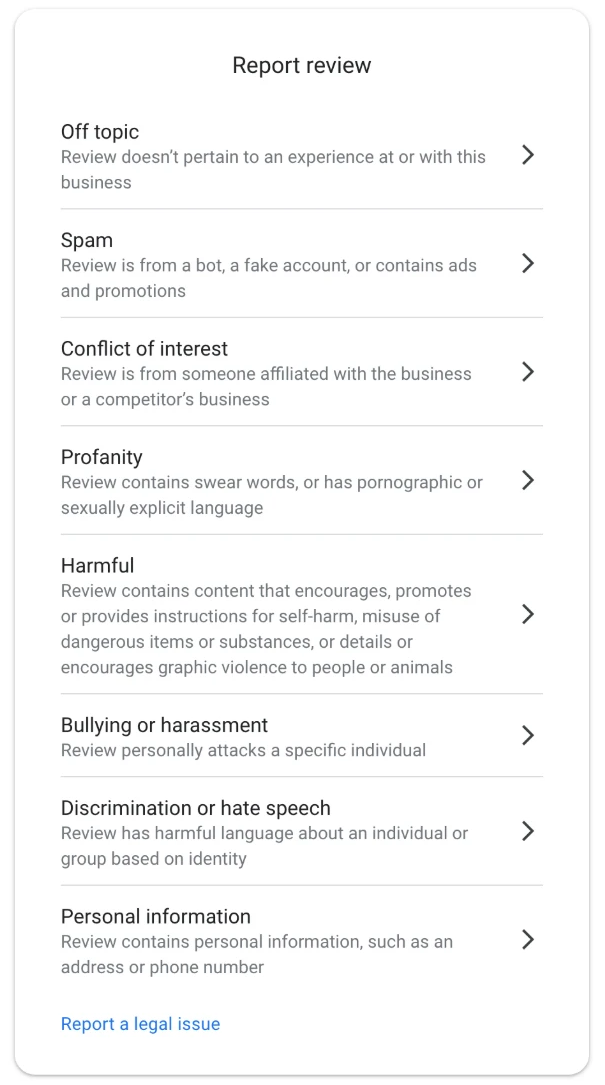
The report reasons in the Reviews Management Tool. For swearing with a target, or sexual content, pick Profanity.
The exception is the named-employee case above, which goes in as Bullying or harassment on every screen. Take a screenshot before reporting, report from the account that manages your profile, and do not ask friends or staff to report it too; coordinated reporting is treated as manipulation. Our guide to reporting a Google review as the business owner shows each route.
The appeal, if the report is declined
A "no policy violation" decision makes the review eligible for one appeal. This is the one place where the report reason and the policy name part ways, and owners trip on it.
- Swearing aimed at a person or the business: type Obscenity & profanity in the policy field.
- Sexual content: type Sexually explicit content, even though you reported it as Profanity.
The explanation quotes the words exactly as written, masked or not, and shows who or what they are aimed at. It says nothing about what happened at the counter. The appeal templates for both breaches are in The Google Review Removal Playbook. If you have not lodged an appeal before, what to write in a Google review appeal explains what the reader on the other end is looking for.
While you wait, reply to the review without repeating the language or mentioning the report. Every reader sees the difference in tone, and if the review comes down, your reply goes with it.
Before you report a review for swearing, draw an arrow from each swear word to whatever it points at: if an arrow lands on a person or on your business, report it as Profanity today; if every arrow lands on nothing, answer the complaint instead.
Swearing with a target comes down
Appeal templates for targeted swearing and sexual content, plus the Harassment template for when the swearing is aimed at a named employee.
Get the Playbook · $99Several locations or a group? Talk to us about a managed service · Popular locations: Sydney · Melbourne · Brisbane · Perth · Adelaide · Gold Coast · all locations