Sexual Content in a Google Review: What Google Removes and How to File It
2026-09-24
A review on your profile has crossed into sexual territory. It might be a graphic description that has nothing to do with the service, a crude comment about a staff member's body, or an innuendo about what really goes on in your treatment rooms. Customers are reading it, and so is the person it is about.
Some of these reviews come down on one rule, some on another, and some stay. The route depends on exactly what the words say and who they are aimed at, and the report screen does not make it obvious.
What the rule covers
Google's Sexually explicit content policy covers explicit sexual descriptions and content written to be sexually gratifying. It applies whoever the content is about: you, your staff, the reviewer, or nobody in particular.
Wording that qualifies is graphic by definition, so we will describe it rather than invent it. The case exists when the review:
- describes a sexual act in explicit terms
- describes someone's body in a sexual, explicit way
- exists to be sexual rather than to describe any service
As with every breach, the reviewer does not have to be fake. A real customer who writes an explicit passage into an otherwise ordinary complaint has broken the rule, and that passage is the case.
Wording that only looks similar
Plenty of reviews are unpleasant, suggestive or rude without being explicit.
- "The receptionist was flirting with the guy ahead of me instead of working." Unflattering, not explicit. It describes behaviour, and that is allowed.
- "Bit of a meat market on a Saturday night." A comment about the atmosphere, not a sexual description.
- "Came out very relaxed, if you know what I mean." An innuendo. It is not explicit, though it can do real damage to a massage clinic, a spa or a salon.
For that last kind, look at what it is really saying. If a review states as fact that your business is something other than what it says it is, it is closer to a label about your business than to explicit content. Our post on reviews calling your business a scam explains the difference between a label stated as fact and a hint, and that is the lens to use.
Crude remarks about a named staff member
This is the most common version we see, and the one where the obvious route is not the strongest.
A review that says something crude about the body, looks or availability of a named employee is usually not graphic enough to be sexually explicit. It is, however, a personal attack on an identifiable person, and that is a separate breach and usually the stronger choice: a personal attack on a named employee, filed under Harassment.
Invented example, with the name removed: "Ask for [name] on the front desk, she's the only reason to go back." Named, reduced to her looks, and nothing to do with the service. That is an attack on a person.
So the rule of thumb is:
- Graphic and explicit, whoever it is about: Sexually explicit content.
- Crude and aimed at a named staff member: the personal-attack breach, which is covered in full in our post on reviews that attack an employee.
Pick one. One policy, well argued, beats two thrown at the same review.
How to report it
- Take a screenshot of the review with the date visible, and keep it somewhere private, not in a staff group chat.
- Open the Reviews Management Tool, signed in to the account that owns or manages your Business Profile. Our guide to the Reviews Management Tool walks through each screen.
- Choose Report a new review, click Report beside the review, and pick Profanity.
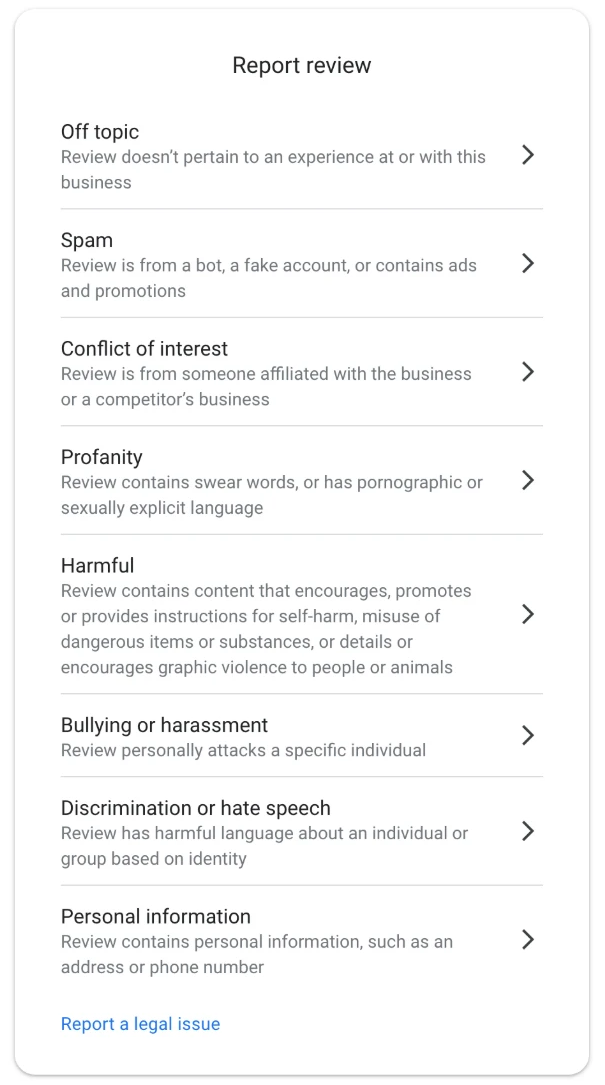
The eight reasons offered in the tool. There is no sexual content option, so pick Profanity for explicit content.
Profanity is the right choice for explicit content because there is no separate sexual content reason on any of the report screens. The reason gets the review into the right queue, and the appeal is where you name the exact policy in your own words. Profanity is offered in the tool, on your business panel on Search, and on the public listing and Maps app.
For a crude remark aimed at a named staff member, pick Bullying or harassment instead, as covered in the employee post.
The appeal, if the report is declined
A first report can come back "Report reviewed, no policy violation", even on something plainly explicit. That opens the appeal. Here is what to do after a "no policy violation" decision.
For explicit content, type Sexually explicit content in the policy field, not Profanity. The report reason and the policy name are different here, and the appeal is where you get to be exact. In the explanation, quote the explicit words, say plainly that they are sexually explicit and unrelated to any product or service, and ask for removal. You do not need to explain why they are offensive. The words do that on their own.
Keep the appeal short and flat. No commentary on the reviewer, nothing about the visit, and no second policy added for weight. The Google Review Removal Playbook has the template for this breach, along with the note on when the employee template is the better choice.
You get one appeal per review. If the appeal step shows "Error accessing the workflow", that is a known fault on Google's side, and this is how to get past it.
Looking after the staff member
If the review is about someone on your team, deal with them before you deal with Google. Tell them yourself, in private, before a customer or a colleague mentions it. Let them know you have reported it, that it says nothing about them or their work, and that you will not be replying in a way that repeats it. Ask what would help: some people want to know every step, others would rather never hear about it again. If they feel unsafe, or the reviewer has contacted them directly, treat it as a workplace safety matter and involve police if needed. They can also report the review from their own Google account, because it is their name and their complaint. That is different from asking other staff or friends to flag it, which is treated as manipulation.
Whether to reply
For explicit content, the best reply is often no reply until the decision comes back. Any reply sits directly under the content and keeps it in view, and there is nothing in an explicit passage to answer.
If the review also contains a real complaint about the service, and you want readers to see you respond, answer only that complaint in a sentence or two, with a direct contact. Something like "I'm sorry the booking did not go smoothly, and I would like to hear more directly" is enough.
What the reply must never do is repeat, paraphrase or joke about the content, or name the staff member it was aimed at. Our post on how to respond when a review names your staff covers how to protect the person while still answering the review.
Before you pick a reason, ask one question: is this explicit, or is it crude and aimed at someone on your team? The first is Profanity at report and Sexually explicit content at appeal; the second is Bullying or harassment, and it is usually the stronger case.
Protect your team from explicit reviews
The playbook shows which template to use for explicit content and which for a crude remark about staff, and how to file each one.
Get the Playbook · $99Several locations or a group? Talk to us about a managed service · Popular locations: Sydney · Melbourne · Brisbane · Perth · Adelaide · Gold Coast · all locations